CNC AUTOMATION BASICS
Robotic Machine Tending 101: When Is Automation Worth It?
01What is robotic machine tending? The first step in CNC automation
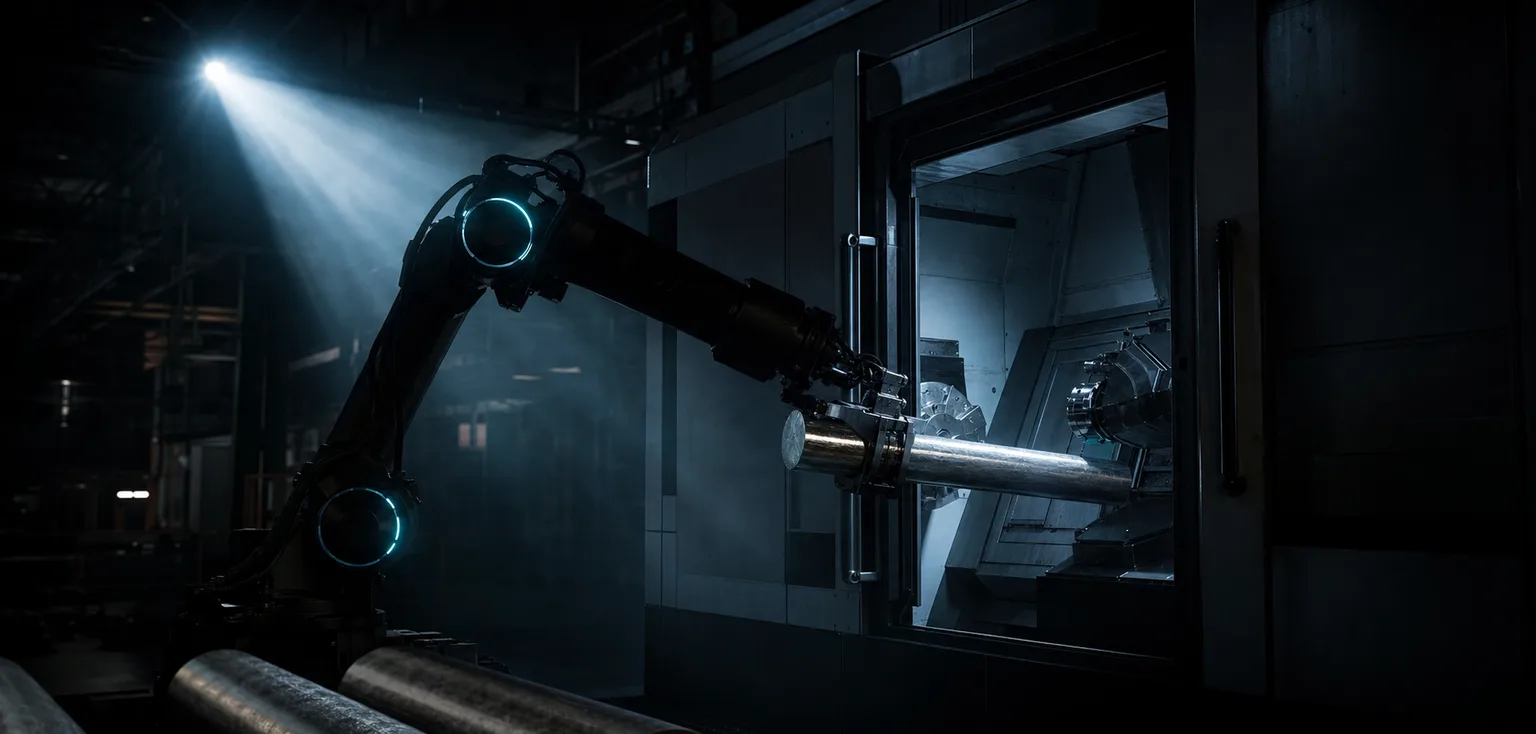
Robotic machine tending means using automation equipment instead of manual labor to place raw blanks into the CNC machine and, after machining, remove the finished part. It is the first segment most job shops consider when moving into CNC automation, because loading/unloading is a typically repetitive, monotonous and standardizable operation that falls right in the range automation handles best.
In the classic architecture of automation and production systems, material handling and workpiece loading/unloading are fundamental functions that support the operation of machining equipment; changing this segment from manual to program control is a common starting point for raising machine utilization and letting one person watch several machines (Groover, 2019)[1]. In other words, the goal of loading/unloading automation is not to show off, but to keep the expensive machine from sitting idle as much as possible.
02Four common formats of loading/unloading automation
"Robotic arm" is a colloquial term; in practice there is more than one solution. The automation literature usually distinguishes different types by flexibility and integration approach[1], and applied to the loading/unloading scenario there are roughly four categories:
| Format | Concept | Typical fit |
|---|---|---|
| Gantry robot | Linear pick-and-place along an overhead rail, with a fixed motion path | Volume production with fixed part types, regular arrangement and stable cycle time |
| Magazine / tray automatic feeding | Feeds in sequence via a vibratory bowl, magazine or tray, with a relatively simple mechanism | Small parts with consistent shape that can be stacked and arranged |
| Articulated arm robot (6-axis) | Multiple degrees of freedom, can go around obstacles, with flexible pickup poses | More complex part types that need flipping, or one arm shared across several machines |
| Collaborative robot (cobot) | Can stand close to people, with faster deployment and teaching | Production lines with limited space, medium batches, needing mixed human-robot operation |
None of the four formats is absolutely better or worse; the difference lies in flexibility, footprint, integration difficulty and cost. Gantry and magazine solutions have a simple structure and high reliability but low changeover flexibility; the articulated arm has the highest flexibility but larger fixture and teaching investment; the collaborative robot saves fencing and deploys quickly but is usually limited in payload and speed. Selection should start from the part and cycle-time conditions, not from falling in love with a particular piece of equipment first.
03What parts suit automation? Three judgment conditions
Manufacturing-engineering textbooks remind us that the choice of process and degree of automation essentially depends on production volume and part consistency—only parts with high volume and stable specifications can amortize the fixed investment in dedicated fixtures and integration (Kalpakjian & Schmid, 2020)[2]. Applied to loading/unloading, three conditions offer a quick judgment:
- Is the batch stable: only if the same part number has continuous, predictable order volume does automation's build cost have enough time to be amortized; one-off small orders are usually not worthwhile.
- Is clamping standard: only if the part has flat, consistent gripping faces and locating datums is gripper design simple and pickup reliable. For irregularly shaped, easily deformed or oily-and-slippery parts, gripper development cost rises sharply.
- Is the single-part cycle time suitable: only if the machining time is long enough does the robot have room to complete pick-and-place while the machine is cutting; conversely, if a part finishes every few seconds, manual reloading may not be the bottleneck, and automation's benefit is also limited.
When all three conditions hold, the benefit of loading/unloading automation is clearest: machine utilization rises, operation continues through nights and shift handovers, and labor is freed up for work that requires judgment.
04When not to rush into automation
Honestly, not every shop or every part is suitable for adding a robot right now. In the following situations, it is better to wait and lay a solid foundation first:
- Low-volume high-mix, frequent changeovers: with many part numbers and small quantities of each, changeovers require redesigning or adjusting grippers and rewriting paths, and the switching cost eats up the machine hours automation saves.
- Immature clamping conditions: when the part shape is still changing, datum faces are not fixed, or manual judgment of placement orientation is needed, forcing automation will only lead to constant stoppages to clear anomalies.
- The process itself is not yet stable: when tool life, dimensional consistency and program reliability are still fluctuating, stabilizing the machining process and quality first is more important than automating material handling first.
In other words, automation amplifies a process that is "already stable"; if the process itself is not yet stable, automation will only amplify the problems faster. In this case, starting from a standardized process and smoothing out machining preparation is often the more pragmatic starting point—you can refer to the evaluation logic in "Where Should the First Step of Smart Manufacturing Begin?"
05Evaluation factors: cycle time, fixturing, safety and human-robot collaboration
What truly determines the success or failure of a loading/unloading project is often not the robot body itself, but the surrounding integration details. Before adoption, inventory each item:
- Cycle-time matching: lay out the machining time, pick-and-place time and part-replenishment frequency, and confirm that the robot's rhythm can align with the machine's machining rhythm without waiting on each other.
- Fixtures and locating: the design of grippers, locating fixtures and trays is often the most time-consuming part of a project; pickup stability and repeatable positioning accuracy directly determine yield.
- Safety guarding: traditional articulated arms mostly need safety fencing, light curtains and interlocks; while a collaborative robot can save the fencing, it still requires risk assessment and speed/force limits. Safety design is not an option but a prerequisite for going live.
- Human-robot collaboration and information linkage: the robot, machine, measurement and management systems need to be able to share state. The modern manufacturing practice of tightly integrating equipment and information systems so that physical processes and digital information correspond in real time is exactly the core spirit of cyber-physical systems (CPS) (Monostori et al., 2016)[3]—if loading/unloading automation can link utilization, anomaly and output data together, the value far exceeds simply moving material.
To learn more about how to collect machine state and utilization data and turn it into analyzable information, further reading: "Machine Data and OEE: Reading Utilization with AI."
06A common misconception: does automation equal a lights-out factory?
The most common misconception is to equate "automation" directly with a "lights-out factory." In fact, the vision of cyber-physical systems emphasizes the collaboration of people and automation systems, not excluding people[3]. What robotic machine tending can take over is the repetitive labor of "tending the machine and reloading"; but the following work will not be able to do without people in the foreseeable future:
- preparation of machining programs, first-article confirmation and parameter adjustment;
- tool management, wear judgment and tool-change decisions;
- diagnosis and on-site resolution of quality anomalies;
- fixture maintenance, robot teaching and routine upkeep.
The biggest risk of understanding automation as a lights-out factory is underestimating the hidden investment in fixtures, teaching and maintenance, leading to unmet expectations. The pragmatic goal is fewer people and amplified capacity—letting one person watch more machines at once and invest time in work that requires judgment, rather than fantasizing about lights-out production overnight.
07Automation tends the machine, AI tends the programming: two complementary answers to the labor shortage
The pressure of the labor shortage actually appears in two places at once: no one to tend the machine on the production line, and no one in the office to quickly turn drawings into machine-ready programs. These two bottlenecks correspond to two different answers, and they can run in parallel:
| Answer | Segment solved | Value |
|---|---|---|
| Robotic machine tending | Tending the machine, reloading (production-line end) | Amplifies single-machine capacity, raises utilization, frees on-site labor |
| AI-assisted machining preparation | Drawing reading, modeling, programming (office end) | Shortens preparation time before the machine runs, standardizes the veteran master's interpretation |
The two are not an either/or. Automation tending the machine keeps the machine from sitting idle; AI tending the programming gives the machine a program to run; which to do first depends on whether your biggest bottleneck right now falls on the production line or in the office. If your pain point is "the drawing arrives but the program can't be produced, and quoting and machine startup are both stuck at the preparation stage," then starting from machining preparation usually pays off faster and is easier to get going. This complementary relationship is explained more fully in "A CNC Labor-Shortage Self-Help Guide: How AI-Assisted Programming Lets One Person Watch More Machines."
08FAQ
Does robotic machine tending require buying an entire robot?
Not necessarily. Loading/unloading automation comes in many formats—gantry pick-and-place, magazine feeding, articulated arms and collaborative robots all count. When the part is simple and the cycle time is fixed, a magazine or gantry solution usually has lower investment and integration difficulty than an articulated arm; a collaborative robot suits situations with limited space where it must stand close to people. Choose the format from the part and cycle-time conditions first, don't lock onto equipment first.
What kind of parts suit robotic machine tending?
Parts with stable batches, regular shapes, standard clamping faces and a single-part cycle time that isn't too short are the best fit. Stable batches let you amortize fixture and integration costs; standard clamping keeps grippers simple and pickup reliable; when the cycle time is too short, manual reloading may not be the bottleneck. Low-volume high-mix, frequently changed-over, hard-to-clamp parts are not recommended for automation from the start.
Does adopting robotic machine tending mean a lights-out factory?
No. Automated loading/unloading solves the repetitive labor of "tending the machine and reloading," letting one person watch more machines, but program preparation, first-article confirmation, tool management, quality judgment and anomaly troubleshooting still require people. Treating automation as a lights-out factory easily underestimates the hidden investment in fixtures, teaching and maintenance. The pragmatic goal is fewer people and amplified capacity.
What is the relationship between robotic machine tending and AI machining preparation?
The two solve different segments of the labor shortage and cover for each other. Robotic machine tending solves "tending the machine"—moving parts in and out so the machine doesn't sit idle; AI-assisted machining preparation solves "programming preparation"—quickly turning 2D drawings into verifiable 3D models and G-code. Which to do first depends on whether your biggest bottleneck right now is on the production line or in the office.
Get notified when new articles and video briefings go live—no inbox spam, unsubscribe in one click. (newsletter in Chinese)
START WHERE THE BOTTLENECK IS
First make the "programming preparation" segment faster
Whether or not you add a robot later, machining preparation is a segment every order has to go through. We help you evaluate how to use AI to quickly turn drawings into verifiable programs.
Contact an onboarding advisor Training courses09References
- Groover, M. P. (2019). Automation, Production Systems, and Computer-Integrated Manufacturing (5th ed.). Pearson.
- Kalpakjian, S., & Schmid, S. R. (2020). Manufacturing Engineering and Technology (8th ed.). Pearson.
- Monostori, L., Kádár, B., Bauernhansl, T., Kondoh, S., Kumara, S., Reinhart, G., Sauer, O., Schuh, G., Sihn, W., & Ueda, K. (2016). Cyber-physical systems in manufacturing. CIRP Annals, 65(2), 621–641.