SURFACE TREATMENT FOR CNC PARTS
Anodizing, Black Oxide, or Nickel Plating—How to Choose? A Guide to Speccing Surface Treatment for CNC Parts
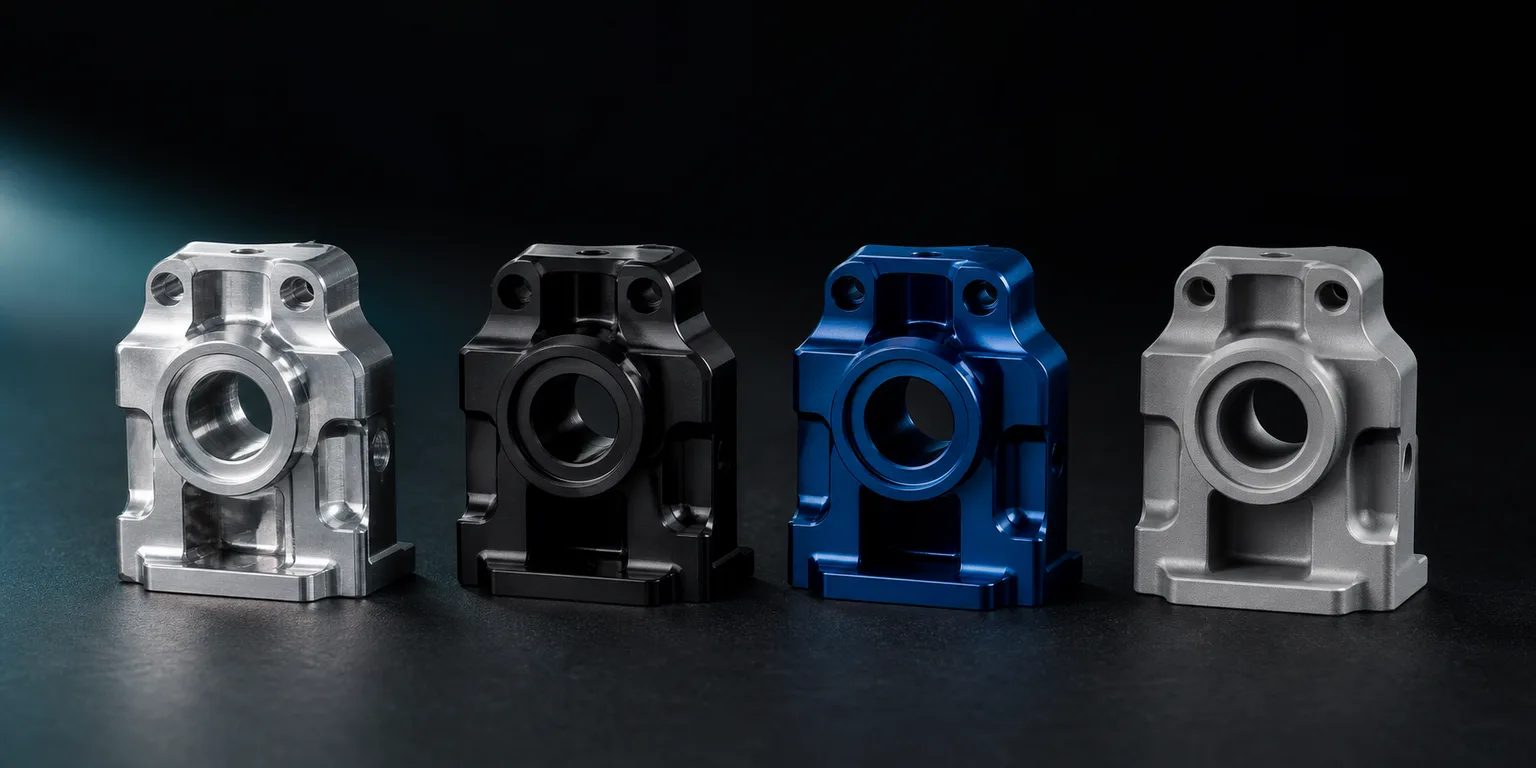
Note: this product does not provide surface-treatment services. Our role is to help you get the process order and drawing callouts right before you outsource, and the AI can also recognize surface-treatment callouts during early drawing review and flag them for human confirmation.
01Why Surface Treatment Needs to Be Thought Through at the Design Stage
Surface treatment isn't a last step you tack on after machining—it's a design decision that reaches back to affect dimensions, tolerances, and process order. Classic manufacturing-engineering textbooks devote a whole chapter to surface treatment and coatings precisely because it involves a full set of engineering considerations—material, corrosion, wear, and adhesion—not merely "adding color" (Kalpakjian & Schmid, 2020)[1]. For the same aluminum part, choosing standard anodizing versus hard anodizing determines its wear resistance and how much dimensional margin you leave for the coating thickness.
From a manufacturing-systems perspective, a product's quality and cost are determined jointly by the whole process chain; if any one station's spec isn't aligned with the stations before and after it, it surfaces downstream as rework or scrap (Chryssolouris, 2006)[2]. Surface treatment is exactly the station most likely to be "left until last" yet most likely to bite back on dimensions, which is why it's worth spelling out before you send the job.
02Comparing Common Surface Treatments: Anodizing, Hard Anodizing, Black Oxide, Nickel/Chrome Plating, Bead Blasting, Passivation
The table below qualitatively summarizes several surface treatments you most often encounter on CNC parts to help you narrow the direction first; the actual spec and each supplier's capabilities should still be confirmed case by case.
| Treatment | Appearance | Corrosion resistance | Hardness / wear | Common suitable materials |
|---|---|---|---|---|
| Anodizing (standard anodize) | Can be dyed in various colors, matte or glossy | Good | Medium | Aluminum, aluminum alloys |
| Hard anodizing (hardcoat) | Mostly dark gray/black, deeper in tone | Excellent | High, good wear resistance | Aluminum alloys (sliding, wear-resistant functional surfaces) |
| Black oxide (blackening) | Black, low gloss | Basic (needs an oil seal) | No hardness gain | Carbon steel, alloy steel |
| Nickel / chrome plating | Bright silver-white / bright metallic look | Excellent | High (especially hard chrome) | Steel, copper, some aluminum (needs an underplate) |
| Bead blasting | Uniform matte, non-glossy | None (mostly pre-treatment or appearance) | No hardness gain | General metals, often as pre-anodize prep |
| Passivation | Barely changes appearance | Improves stainless corrosion resistance | No hardness gain | Stainless steel |
A few practical rules of thumb: for aluminum parts that need both appearance and corrosion resistance, anodizing is the usual choice, with hardcoat on functional surfaces that must resist wear; for steel parts that want a low-cost uniform black and aren't too concerned about coating thickness, black oxide is common; when you need a bright finish and high hardness and can accept the cost of plating, go with nickel or chrome; stainless steel usually just needs passivation to restore its corrosion resistance; and bead blasting often serves as a matte finish or as surface prep before anodizing. Corrosion and wear are two different failure mechanisms, so before choosing, confirm which one you're really up against (Kalpakjian & Schmid, 2020)[1].
Appearance and roughness are related too: the surface state before bead blasting and anodizing affects the final texture, so if you have specific surface-roughness requirements, it's worth also reading How to Read Surface Roughness Ra Values to align Ra with your expectations for the treated appearance.
03Coating Thickness Grows Dimensions: The Real Impact on Tolerances
The point most often overlooked yet most likely to cause trouble is this: surface treatments that "grow a film" change a part's dimensions. Anodizing and plating create an oxide film or metal layer on the surface, so outside dimensions grow outward, while internal features like hole diameters and grooves shrink relatively. Because hardcoat has a thicker coating, this effect is more pronounced. If you set tolerances at the bare, as-machined state, then after treatment the coating thickness may eat up the fit clearance, so a pin won't insert, a thread seizes, or a fit is too tight.
At heart, this is about aligning specs across process stations: the dimension the machining station produces, together with the coating thickness the treatment station grows, is what equals the finished dimension in the customer's hands. If either end computes in isolation, it falls apart at assembly (Chryssolouris, 2006)[2]. So treating the "after-treatment dimension" as the true target and working backward to the machining dimension is the safer approach.
04The Sequence of Machining and Surface Treatment
The general rule is to finish CNC machining first, then send the part for surface treatment, so the treatment layer fully covers the finished surface. But whenever a part has both an "appearance surface to be treated" and a "mating surface that can't be affected by coating thickness," the order and masking must be agreed in advance. Common trade-offs include:
- Tapped holes and threads: coating thickness makes internal threads smaller and external threads larger, so decide whether tapping happens before or after treatment, or specify masking of the threads.
- Precision mating faces / datum faces: you can choose to mask and keep them bare, or schedule final finish-machining and measurement after treatment.
- Deburring and cleaning: most treatments need a good surface state beforehand, since burrs and oil affect adhesion and appearance uniformity.
From a systems view, this is really about planning the process order as a design variable—get the order wrong and film grows where it shouldn't, or a critical face loses its precision after treatment (Chryssolouris, 2006)[2]. It's part of thinking about manufacturability; to more systematically avoid this kind of landmine at the design stage, read on in The CNC Design-for-Manufacturability (DFM) Guide.
05What to Call Out on the Drawing When Sending a Job Out
Writing the surface-treatment requirements into the drawing, rather than leaving them in conversation or a message, is the most effective way to align quoting, machining, and treatment. When sending a job out, call out at least:
- Treatment type and spec: such as "hard anodize," "black oxide on steel," or "nickel plating," with color and appearance-grade requirements where needed.
- Treated versus untreated areas: use designated faces or masking symbols to mark which faces are treated and which are masked to keep the bare material.
- Tolerance basis: clearly mark whether dimensional tolerances are "before treatment" or "after treatment," especially for mating faces, hole diameters, and threads.
- Functional need: state the real purpose (corrosion resistance, wear resistance, conductivity, appearance consistency) so the treatment shop can work back to suitable parameters.
Manufacturing-systems research repeatedly shows that passing complete information upstream in the process chain significantly lowers downstream misunderstanding and rework cost (Chryssolouris, 2006)[2]. A drawing that spells out surface treatment saves every downstream station the time of repeated back-and-forth. For how to negotiate the quote and lead time, read this alongside The CNC Job-Sourcing Guide.
06Where AI Drawing-Reading Draws the Line on Surface-Treatment Callouts
In the flow where AI reads a drawing early on, a surface-treatment callout is a textbook example of something that "can be recognized but needs human confirmation." The AI can detect that surface-treatment-related text or symbols appear on the drawing (for example, a callout for anodize, black oxide, plating, or a masked area) and, during modeling and quoting, proactively flag "there's a surface-treatment requirement here—please confirm the tolerance basis and masking scope." This keeps the requirement from being missed and stops the problem before the job goes out.
But the line is clear too: this product does not provide surface-treatment services, and the AI won't decide for you which treatment to use or how much margin to add for coating thickness. Those judgments involve functional needs, supplier capabilities, and measured coating thickness, and remain a collaboration between the designer and the treatment shop. The AI's role is to recognize the surface-treatment information on the drawing, align it to the correct process order and dimensional basis, and let a human make the final call—consistent with the positioning across the whole CAD/CAM information chain of "automate the handling of structured information, leave the judgment to the professionals" (Kalpakjian & Schmid, 2020)[1].
07FAQ
What's the difference between anodizing and hard anodizing (hardcoat)?
Both are electrochemical oxide treatments for aluminum; the difference is coating thickness, hardness, and use. Standard anodizing emphasizes appearance, coloring, and basic corrosion resistance with a thinner coating; hard anodizing targets wear and corrosion resistance with a thicker, harder coating, and is commonly used on sliding parts and functional surfaces that need to resist wear. Hardcoat's thicker film has a more pronounced effect on dimensions and tolerances, so leave margin in the design and call it out clearly on the drawing.
Does surface treatment affect a part's dimensions and tolerances?
Yes. Film-growing treatments like anodizing and plating make outside dimensions grow outward and hole diameters shrink relatively; bead blasting and the like slightly alter the surface. For mating faces, hole diameters, and threads, the drawing should clearly mark whether the tolerance is "before treatment" or "after treatment," and note whether critical faces are masked off, so coating thickness doesn't eat up the fit clearance.
Should I machine first or treat the surface first?
Generally, finish CNC machining first, then do surface treatment so the treatment layer covers the finished part; but if there are tapped holes, mating faces, or surfaces to be finish-machined later, agree in advance on masking or leaving margin. Critical fit dimensions are best confirmed after treatment, or preserved as bare surfaces by masking. When the order isn't spelled out, you often get film where it shouldn't be, or a failed fit.
What should the drawing call out about surface treatment when sending out a job?
At minimum, spell out: the treatment type, color and appearance requirements, which areas are treated versus masked, whether the tolerance is before or after treatment, and the functional need for corrosion or wear resistance. Putting it on the drawing rather than conveying it verbally aligns quoting, machining, and treatment, and lets the AI recognize the surface-treatment callout during early drawing review and flag it for human confirmation.
Get notified when new articles and video guides go live—no inbox flooding, unsubscribe in one click.
GET THE PROCESS ORDER RIGHT
Before You Send a Job Out, Get the Process Order and Drawing Callouts Right
We don't do surface-treatment work, but we can help you clarify the order of machining and treatment, the tolerance basis, and the drawing callouts before you outsource—so the AI flags the surface-treatment requirements during early drawing review.
Talk to a rollout consultant Training courses📋 Download the free CNC Job-Sourcing Checklist (printable) (中文)
08References
- Kalpakjian, S., & Schmid, S. R. (2020). Manufacturing Engineering and Technology (8th ed.). Pearson.
- Chryssolouris, G. (2006). Manufacturing Systems: Theory and Practice (2nd ed.). Springer.