MEDICAL DEVICE MACHINING × AI CNC
Medical Device CNC Machining: Stainless and Titanium, Surface Quality, and Documentation
01What is medical device CNC machining?
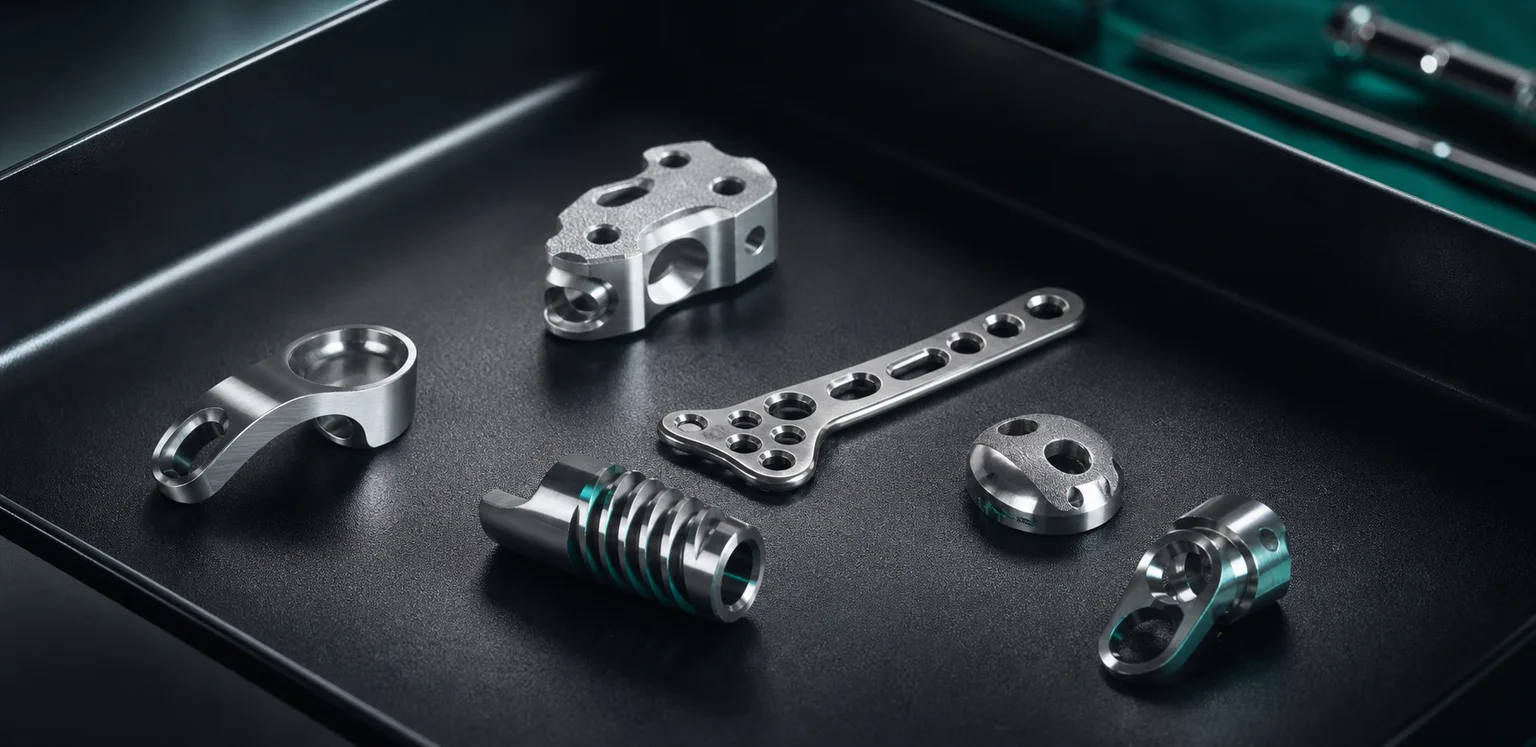
Medical device machining (medical-device CNC) broadly refers to using CNC milling, turning, and other cutting processes to make implants, surgical instruments, orthopedic and dental components, surgical tools, and all sorts of precision metal parts. Compared with general industrial parts, what makes medical-device CNC special isn't that any single dimension is hard to make, but that "tough-to-cut materials, strict surface acceptance, a messy mix of items, and every single part needing a record" all happen at once. Only by understanding this scenario can you judge where AI should help and where a professional must keep control.
One boundary worth stating up front: the quality-system requirements common in the medical-device industry (such as quality-management systems like ISO 13485) are audited at the organization and process level, and no machining software can "comply on their behalf." The AI CNC discussed in this article is positioned to accelerate machining prep and produce traceable supporting data — not to claim it achieves any regulatory compliance for the shop.
02Scenario profile: 316L, titanium, and strict surface requirements
The 316L austenitic stainless steel and titanium alloys commonly used for medical parts are both recognized in manufacturing engineering as difficult-to-cut materials: low thermal conductivity, heat concentrating at the cutting edge during machining, and a tendency to work-harden — none of which is friendly to tool wear or surface integrity (Kalpakjian & Schmid, 2020)[1]. This means that for the same drawing, switching to 316L or titanium requires adjusting cutting parameters, tool selection, and cooling strategy accordingly — you can't carry over your intuition from aluminum parts.
Surface quality is another core concern. Parts in contact with or implanted in the body often have explicit acceptance thresholds for surface roughness (Ra), burrs, and appearance, and deburring and polishing are frequently separate, mandatory operations. Textbooks also note that the choice of machining parameters directly shows up in surface integrity and dimensional accuracy[1], so in the medical scenario "hitting the dimension" and "hitting the surface" are two goals you must both attend to. In summary, this scenario has three hallmarks:
- Materials are mostly difficult-to-cut: 316L stainless, titanium alloys, and some cobalt-chrome alloys, all sensitive to tools and parameters.
- High surface and deburring demands: Ra and appearance have acceptance standards, and post-processing operations can't be skipped.
- Small-batch, high-mix: orders are often a few to a few dozen pieces, items change frequently, and changeover and setup happen often.
03The three big pain points of medical-part shops
Translate the scenario profile into everyday headaches and medical-part shops most often hit three pain points:
- Tough materials: the parameter window for stainless and titanium is narrow, and a slight slip means rapid tool wear, work-hardening, or surface burn — trial-cut costs are high, and the cost of scrapping even one part is high too.
- Strict surface acceptance: passing the dimension doesn't mean you can ship it; if any one of Ra, burrs, or appearance falls short, it's rework — and rework on difficult-to-cut material is another high-risk machining pass.
- Small quantities but heavy paperwork: small-batch high-mix makes machining prep (reading drawings, modeling, programming, verification) take up a disproportionate share of total labor hours, while every item must also have a complete traceable record. The "standardized, traceable process information" long emphasized in the automation and computer-integrated manufacturing literature is a hard requirement in the medical scenario, not a bonus (Groover, 2019)[2].
In other words, the cost of medical-device CNC lies not only in the cutting itself, but even more in the repeated prep and the heavy documentation work — which is exactly where AI has an opening to help. If your items also lean toward difficult-to-cut materials and strict surfaces, the next two sections will be closer to your situation.
04How AI CNC responds: reading drawings, constraints, and traceable verification
Against the pain points above, AI CNC's capabilities can be broken into four links, each strictly observing the boundary of "AI accelerates, professionals keep control":
| Pain point | AI CNC's response |
|---|---|
| Reading drawings and modeling is slow; many items | AI reads the 2D drawing (DWG preferred / PDF / photo as backup) and automatically builds a 3D model, and a second AI cross-checks the model's dimensions against the original drawing's annotations and proactively flags anomalies |
| Difficult-to-cut materials are parameter-sensitive | Cutting parameters are generated with the shop's existing material-tool parameter tables as boundaries; AI doesn't improvise; both 316L and titanium follow the shop's validated windows |
| Strict surface acceptance; costly rework | Finishing paths and stepovers are chosen based on surface requirements, and tool marks, rest material, and interference are previewed in 3D cutting simulation to stop problems before the machine |
| Small quantities, heavy paperwork | The modeling basis, simulation results, and dimensional verification reports can be stored automatically as supporting material for the quality system |
The parameter-constraint point deserves special emphasis. For difficult-to-cut materials, feed, spindle speed, and depth of cut must fall within a validated range, or tool wear and surface quality both go out of control — reviews in the machining-monitoring field also note that monitoring tool condition and process signals is a key means of maintaining cutting quality and catching anomalies early (Teti et al., 2010)[3]. So in the medical scenario, AI-generated parameters should be bounded by the shop's standard parameter tables and paired, during the trial-cut stage, with a technician's reading of tool wear and surface condition — rather than having the model produce values out of thin air. For the surface-related trade-offs, see the Surface Roughness Ra Guide.
05Documentation and human-in-the-loop: leaving a traceable record
In the medical scenario, the heaviest lift is often not the cutting but the documentation. One of AI CNC's values is precisely turning machining-prep information that used to be scattered and manually compiled into structured, traceable records: for each item, the drawing version, modeling basis, selected tools, cutting-simulation results, and AI dimensional cross-check report can all be retained as supporting material for the shop's existing quality system. Traceability is itself one of the core aims of computer-integrated manufacturing (Groover, 2019)[2], and AI makes it both less effortful and more consistent.
But traceable doesn't mean hands-off. The following judgment calls in medical-device CNC still belong to on-site expertise and must be confirmed by a person:
- Tolerances and geometric tolerances (GD&T), and datum setting, which involve assembly and functional intent;
- The final measurement and visual acceptance of surface roughness, burrs, and appearance;
- Reading tool wear on difficult-to-cut materials, finishing allowances, and scheduling of deburring/polishing operations;
- The final sign-off on tool-length offsets, approach/retract, and travel safety before the machine.
This is the meaning of human-in-the-loop: AI handles reading drawings, modeling, producing code, simulating, and cross-checking while leaving a record; professionals handle judgment and final sign-off. For the details of dimensional and measurement cross-checking, see the further reading in AI Applications in CNC Inspection and Measurement, and go back to the product home to understand the full flow.
06Drawing-prep advice for customers placing orders
If you're the party outsourcing medical parts, the following preparation makes AI reading and modeling more accurate and downstream acceptance smoother:
- Provide native electronic drawings like DWG whenever possible: dimensions, hole positions, and threaded holes as structured data are the most reliable to recognize; PDF or scans are second-best, and photos serve only as a backup.
- Clearly note the material and condition: whether it's 316L, Ti-6Al-4V, or another alloy, plus the corresponding heat treatment or surface condition, directly affects parameters and tool selection.
- Write out the surface requirements clearly: the Ra target, faces needing polishing or passivation, and the acceptable degree of burrs should all be marked on the drawing to avoid discovering a gap only at acceptance.
- Mark the key tolerances and datums: please clearly note special tolerances, GD&T, and datum faces; only those not individually annotated are handled by the general tolerance.
- Explain the batch size and delivery cadence: the changeover needs of small-batch high-mix help with scheduling fixtures and machining sequence.
07FAQ
Can AI CNC claim compliance with medical-device quality systems like ISO 13485?
No. ISO 13485 is a quality-management-system requirement common in the medical-device industry, falling within the audit scope of organization and process — not something any single piece of software can achieve or claim compliance with. What AI CNC can provide is traceable machining-prep records as supporting material for the shop's existing quality system; whether it complies is still determined by the shop and the auditor.
For difficult-to-cut materials like 316L stainless and titanium, are AI-generated cutting parameters reliable?
AI should not improvise parameters freely. Stainless and titanium conduct heat poorly and work-harden noticeably, so feed and spindle speed must be generated with the shop's existing material-tool parameter tables as boundary conditions, and confirmed for tool wear and surface condition by a technician during simulation and trial cuts. Constraining parameters within the range validated in-house is the reliable approach.
Medical devices are often small-batch high-mix — does adopting AI CNC make sense?
Precisely because it's small-batch high-mix, machining prep takes up a larger share of total labor hours, so the benefit of AI accelerating this prep is actually more pronounced. AI reading drawings, modeling, and dimensional cross-checking can shorten the lead time for each new item, letting engineers focus on tolerances, surfaces, and datums — the things that truly require judgment.
With strict surface-roughness and deburring requirements, can AI guarantee they're met?
AI can't replace the final measurement. It can select suitable finishing paths and stepovers based on surface requirements, preview tool marks and rest material in simulation, and include deburring and polishing operations in the flow; but the actual Ra, burrs, and appearance still have to be confirmed by on-site measurement and visual acceptance. AI's role is to raise the odds of getting it right the first time and to leave a record — not to waive inspection.
Get notified when new articles and video walkthroughs go live — no inbox spam, unsubscribe in one click.
READY FOR A CONTROLLED PILOT?
Use one medical item to see how much AI CNC can help
From material and surface requirements to the in-house tool library and traceable documentation needs, we help define the way to adopt medical-device CNC that suits your shop.
Contact an adoption consultant Training courses08References
- Kalpakjian, S., & Schmid, S. R. (2020). Manufacturing Engineering and Technology (8th ed.). Pearson.
- Groover, M. P. (2019). Automation, Production Systems, and Computer-Integrated Manufacturing (5th ed.). Pearson.
- Teti, R., Jemielniak, K., O'Donnell, G., & Dornfeld, D. (2010). Advanced monitoring of machining operations. CIRP Annals, 59(2), 717–739.