ON-PREMISE AI & DATA SECURITY
When Customer Drawings Can't Go to the Cloud: On-Premise AI Deployment and an NDA Security Checklist
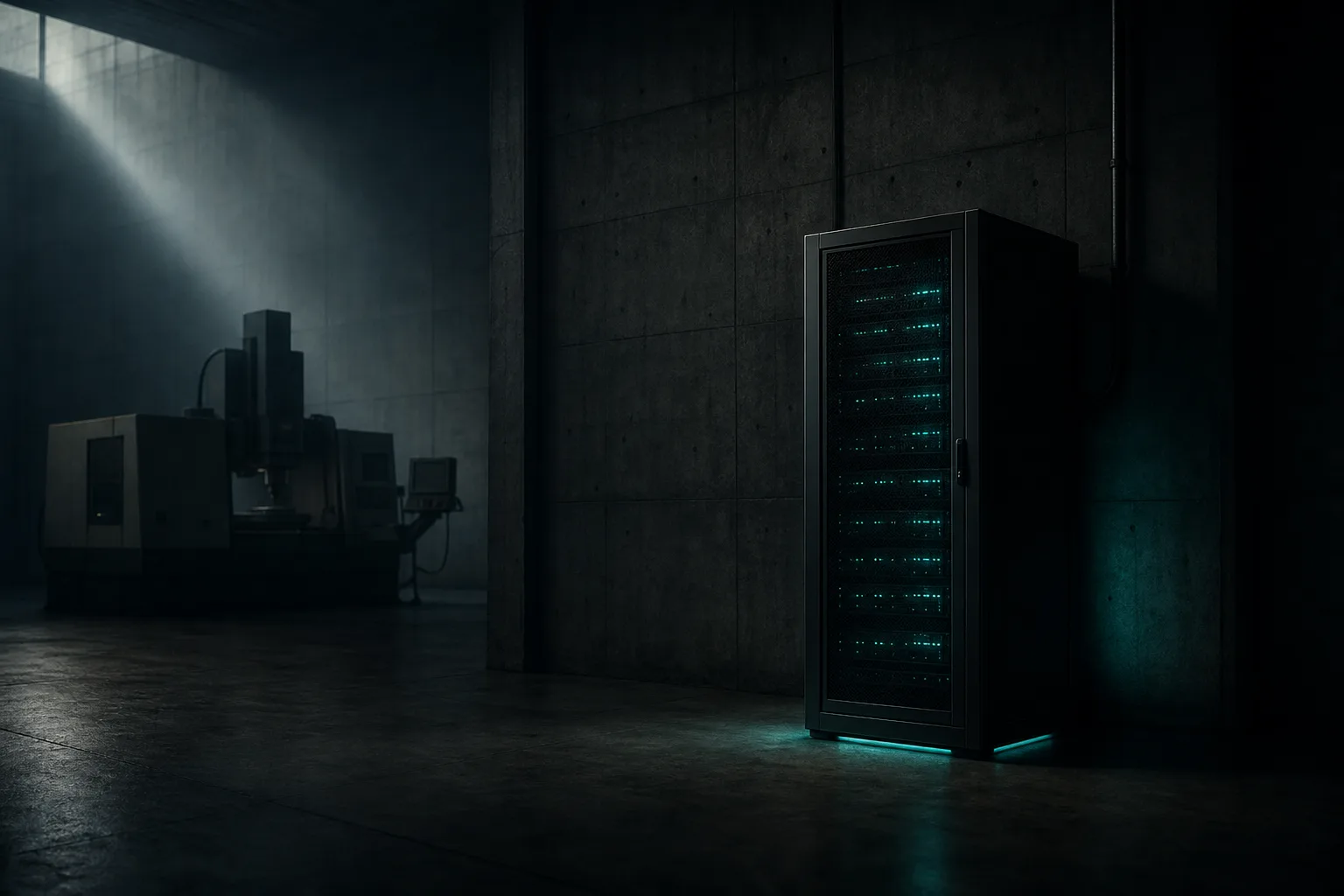
01What is on-premise AI, and why customer drawings can't go to the cloud
On-premise AI refers to a deployment where the AI model is installed on the factory's own dedicated server and computes entirely offline inside the shop, so drawings, product specs, and customer names never leave the site. Its most fundamental difference from "uploading drawings to an external cloud service" isn't whether the algorithm is better or worse, but the physical location of the data and its auditability.
For a CNC job shop, customer drawings are the most sensitive asset. When taking orders for semiconductor equipment, defense and aerospace, medical devices, or competitor parts, customers almost always require a non-disclosure agreement (NDA) that explicitly limits how drawings, specs, and project information may be handled. The moment you drop such drawings into a networked public AI service, the data leaves the boundary you can directly control — and that is exactly the core concern behind "customer drawings can't go to the cloud" in manufacturing information security. Reference architectures for smart manufacturing also remind us that every movement of data — from machine to production line to analytics layer — should be treated as something to be governed and protected, not assumed secure[1].
02Three exposure gaps when drawings go to the cloud
Uploading NDA drawings to cloud AI isn't just a matter of "getting hacked." In practice there are three often-underestimated gaps:
- Data loses control the moment it leaves the shop: once a drawing file is uploaded, it sits on the provider's servers, where it may be cached, written to logs, or — per the terms of service — even used to retrain models. For a drawing under NDA, "the data leaving the site" already constitutes a contractual risk in itself, without any actual leak having to occur.
- Failing supply-chain audits: a large customer's procurement and QA will ask suppliers to explain how data is handled and where it is stored. If the answer is "uploaded to some networked AI," it often fails their security audit, directly affecting your eligibility to win orders.
- Responsibility and trails are hard to establish: in a cloud workflow, the shop usually can't obtain a complete record of who accessed which drawing and when. Without a traceable audit trail, it's hard to prove your innocence once a customer raises a question.
03How on-premise deployment works: a dedicated in-house server and offline computing
On-premise deployment means moving the entire AI workflow into the shop: the model is installed on a dedicated in-house server, and drawing reading, 3D modeling, G-code generation, and dimensional cross-checking are all completed locally, with no external network needed during computation. Drawing files, dimensional specs, and customer names flow entirely within the factory from start to finish, uploaded to no external service.
This architecture lets AI's productivity advantages and security requirements coexist: engineers still enjoy the efficiency of automatic modeling, automatic code generation, and simulation verification, while confidential information is physically confined to the shop. To make this "auditable and provable," the key is to treat the on-premise server as an asset that must be governed, building controls mapped to industrial-control and information-security frameworks — which is the basis for the checklist in the next section.
04The NDA security checklist: four lines of defense
To make "drawings never leave the shop" an auditable management fact rather than just a sales promise, we recommend applying the following four lines of defense to the on-premise AI server. This checklist is deliberately qualitative and item-by-item verifiable, so you can respond point by point against customer NDA clauses and security audit forms. The first two lean toward industrial-network-security concepts and can be mapped to the IEC 62443 series on industrial communication network and system security[2]; the latter two lean toward information-security-management concepts and can be mapped to ISO/IEC 27001 information security management systems[3].
| Checklist item | Key practice | Mapped framework concept |
|---|---|---|
| Network segmentation | The AI server is isolated from the office and production segments, with boundaries drawn using zones-and-conduits thinking and cross-zone traffic kept under control. | IEC 62443 (zones and conduits, defense in depth)[2] |
| No external connectivity | The on-premise server has no outbound network connection and drawing data never lands in the cloud; necessary updates are done in a controlled, offline manner, avoiding a permanent channel to the outside. | IEC 62443 (boundary protection, minimal connectivity) |
| Access control | Manage who can open, copy, and export drawings under least-privilege; separate accounts from roles and revoke access as soon as staff change. | ISO/IEC 27001 (access control)[3] |
| Audit logging | Record drawing access and operation trails (who, when, and what they did to which drawing), keeping traceable logs ready for customer audits. | ISO/IEC 27001 (logging and monitoring) |
The value of these four lines of defense is that they're "provable." When a customer's procurement or QA asks "how do you ensure my drawings don't leak," the shop can produce network topology, offline evidence, a permissions list, and audit logs to explain point by point — rather than just saying "we're careful." For shops taking on high-confidentiality supply-chain orders, this is often the dividing line between winning the order and not.
05Cloud for ordinary jobs, on-premise for NDA jobs: a routing strategy
On-premise deployment doesn't require every single drawing to be processed offline — that would sacrifice flexible compute and rollout speed. The pragmatic approach is to route by confidentiality level:
- Ordinary, non-confidential jobs: controlled cloud is fine, giving more flexible compute and fast iteration — suitable for public specs or low-sensitivity parts.
- NDA, competitor-sensitive, or customer-mandated data-stays-in-the-shop jobs: fully offline on-premise deployment is on the roadmap (evaluated per on-site needs); once available, it applies the four lines of defense from Section 4.
For routing to be executable, the prerequisite is to first establish a drawing confidentiality-classification standard: which customers, which product categories, and which contract clauses count as "must be on-premise," spelled out in the SOP and pushed to the very first step of the intake process, so floor staff know which path a drawing takes the moment it arrives. This "classify first, then map to deployment mode" governance mindset echoes the layered data-flow governance view in smart-manufacturing architectures[1] — information security is not a single switch but a management system designed in layers according to data sensitivity.
Further reading: if you're evaluating the overall cost and benefit of adoption, see Is Adopting AI Worth It for Small and Mid-Size Job Shops? A Cost, ROI, and Controlled-Pilot Evaluation Checklist; to first understand what AI can and can't do on the shop floor, read Generative AI on the Shop Floor: 7 Real Use Cases and Boundaries for CNC Machining; and for the full technical flow from drawing to G-code, there's The Complete Guide to CNC Automatic Programming.
06FAQ
What is on-premise AI, and how does it differ from uploading drawings to cloud AI?
On-premise AI installs the model on the factory's dedicated server and computes entirely offline inside the shop, so drawings, specs, and customer names never leave. Cloud AI uploads drawings to external servers; once data leaves the shop it's beyond your direct control and may be cached, logged, or used for retraining — a risk for NDA drawings. The core difference is the physical location of the data and its auditability.
Do ordinary jobs also have to use on-premise deployment?
Not necessarily. You can route by confidentiality level: ordinary, non-confidential jobs can use controlled cloud for flexible compute; only jobs involving NDAs or a customer requirement that data stay in the shop go on-premise. The key is to first establish a drawing confidentiality-classification standard and write it into the SOP, rather than applying one blanket policy.
How can on-premise AI build auditable security mapped to IEC 62443 or ISO 27001?
Treat the on-premise AI server as an asset that needs protecting: use IEC 62443's zones-and-conduits concept for network segmentation and keep the server off the external network; use ISO 27001's information-security-management concepts to build access control and audit logging. These measures turn "drawings never leave the shop" from a verbal promise into a fact the customer can audit.
If drawings are modeled with AI, will customer names and product specs leak?
Not under fully offline on-premise deployment. Drawing reading, modeling, code generation, and dimensional cross-checking all happen on the shop's dedicated server, and drawings, specs, and customer names are never uploaded externally. With network segmentation, no external connectivity, access control, and audit logging, confidential information stays inside the shop both physically and by policy.
Get notified when new articles and video guides go live — no inbox spam, one-click unsubscribe. (newsletter in Chinese)
NDA-READY DEPLOYMENT
Make "drawings never leave the shop" something you can prove
From drawing confidentiality classification and network segmentation to audit logging, we help define an on-premise rollout that meets your customers' NDA requirements.
Talk to a rollout consultant Training courses07References
- Lee, J., Bagheri, B., & Kao, H.-A. (2015). A Cyber-Physical Systems architecture for Industry 4.0-based manufacturing systems. Manufacturing Letters, 3, 18–23.
- IEC 62443 series. Industrial communication networks — Network and system security. International Electrotechnical Commission.
- ISO/IEC 27001. Information security management systems — Requirements. International Organization for Standardization / International Electrotechnical Commission.