GLOBAL CASE STUDY · KANAZAWA, JAPAN
38 Employees, ¥8 Billion in Revenue: The Real AI Auto-Programming Story of Kanazawa Job Shop ARUM
01Why this case matters: the labor shortage Taiwan and Japan share
In mid-2026, a Japanese TV network aired a feature: "A Kanazawa job shop with 38 employees hits ¥8 billion in revenue with AI!"[6] The business outlet Toyo Keizai used the same question as its headline—"38 employees, ¥8 billion in revenue: why is it possible?"[1]. The protagonist isn't a large manufacturer, but a small company in Kanazawa, Ishikawa Prefecture, named ARUM Inc.
This case deserves serious attention from Taiwan's machining industry—not because the numbers look good, but because the question it answers is identical to ours: skilled workers are disappearing fast, NC programming is heavily dependent on veteran masters, and newcomers can't fill the gap. Toyo Keizai notes that the metal-parts manufacturing ARUM targets is a market on the order of ¥100 trillion, and that the whole industry's shared bottleneck is precisely the shortage of skilled craftspeople[1]. Swap the setting for Taiwan's precision-machining clusters and you barely have to change a word—we laid out the same structural problem in A CNC Labor-Shortage Survival Guide.
02Who ARUM is: from a job shop on the brink to a manufacturing-AI company
ARUM's predecessor, ARUM Works, was founded in 2006 in Hakusan, Ishikawa Prefecture, originally in automation-equipment work. The 2008 financial crisis, compounded by production lines moving to China, led founder Kyoyuki Hirayama to watch small and mid-sized shops around him fold and shut down one after another—large firms could afford automation, but the small factories that actually hold up the supply chain could not. That became the starting point for the company's pivot: it began developing auto-programming AI around 2014, and in 2017 relocated near the Port of Kanazawa and renamed itself ARUM[2].
Today's ARUM is no longer a traditional job shop: it has about 38 employees, roughly 80% of them in engineering roles such as software development[3]. By combining "the machining know-how a job shop understands best" with "a software company's development capability," it produced its core product—ARUMCODE. The software has been recognized with Japan's Good Design Award[5] and a CEATEC AWARD Minister for Digital prize, and it became a Microsoft-published Azure AI customer story[4].
03What ARUMCODE does: CAD in, NC program out
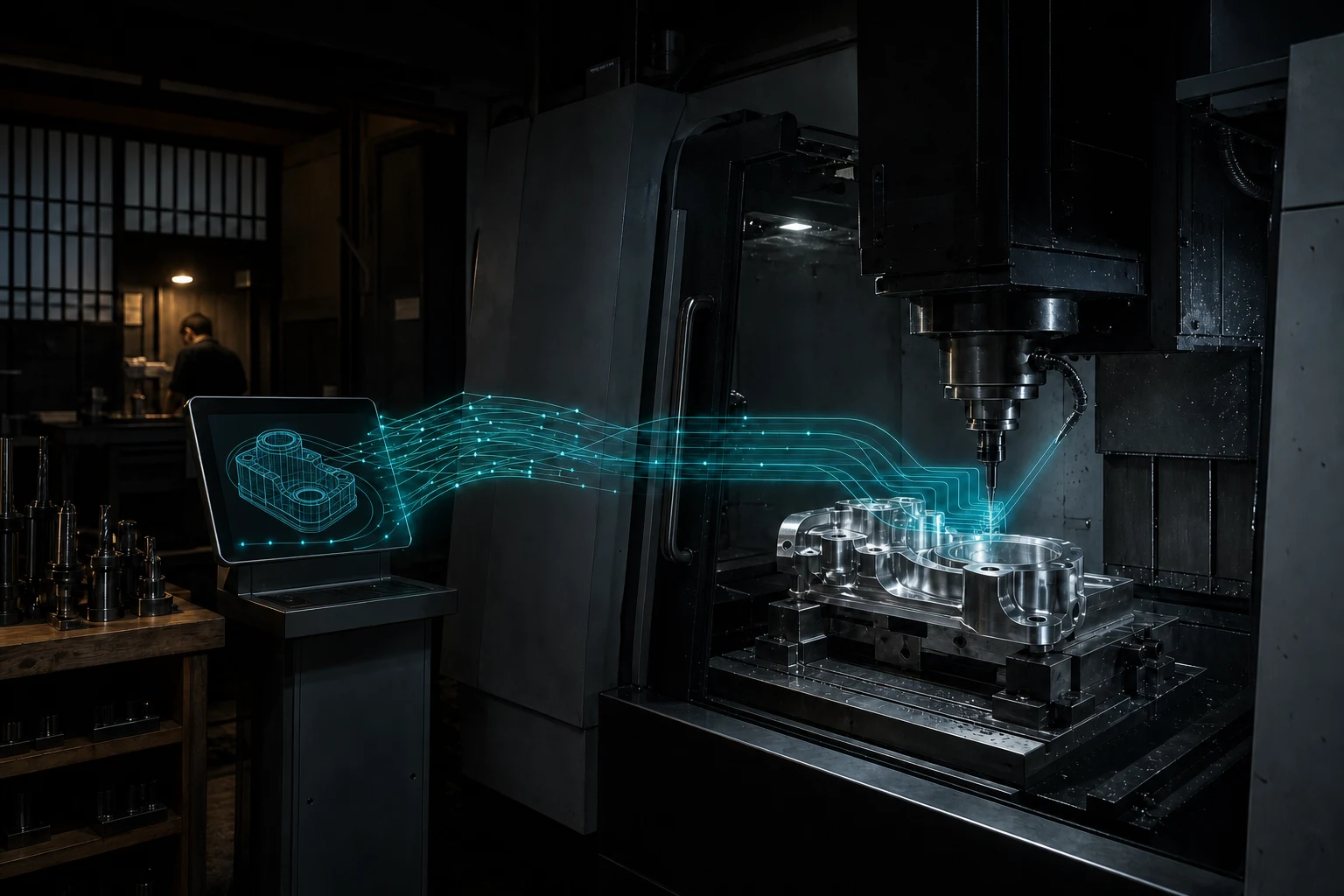
What ARUMCODE does can be said in one line: it turns CAD drawings automatically into machinable NC programs. Break it down, and what it automates is exactly the four prep stages that traditionally rely most on a veteran's experience:
- Geometry parsing: it parses the geometry of 3D CAD data; Nikkei BP reported that its geometry parsing reaches the 5-micron (0.005 mm) level[2].
- Machining-intent recognition: it doesn't just see "a round hole"—it recognizes whether it's a threaded hole or a precision bore, which determines an entirely different downstream machining approach[1].
- Tool selection and cutting conditions: based on that recognition, it automatically selects tooling and computes machining conditions.
- Program and document output: it auto-generates the NC program while also producing a quotation and work-instruction documents, with the compute engine running on Microsoft's cloud[1][4].
Notably, this pipeline—"drawing → feature recognition → tool selection → program → quotation document"—follows the same logic we break down in this blog's complete guide to CNC auto-programming; the only difference is each vendor's design choice for "where humans review." ARUM's existence proves this technical path isn't a lab prototype but a mature product that can carry a company's revenue.
04The verifiable results and business numbers
Case articles are most at risk of inflating figures, so here we list only data with a clear source:
| Item | Figure | Source |
|---|---|---|
| Machining cost at adopting shops | Down roughly 50% | Nikkei BP[2] |
| Machine-tool utilization | Sharply improved from "under 20%" | Nikkei BP[2] |
| Revenue, period ending June 2025 | ¥1.7 billion (4x the prior period) | Nikkei[3] |
| Revenue forecast, period ending June 2026 | ¥5 billion | Nikkei[3] |
| Revenue scale in media coverage | ¥8 billion (about NT$1.6 billion) | Toyo Keizai, TV feature[1][6] |
Two details are worth a second look. First, utilization "under 20%"—the reality many small and mid-sized shops don't want to face: it isn't that there aren't enough machines, it's that programming and prep can't keep up, so expensive equipment sits idle most of the time waiting on programs. Second, revenue growth came from "turning prep work into a product": ARUM didn't grow by taking on more job orders, but by turning its strongest programming know-how into software sold through licensing and subscription services—which is how 38 people can support billions of yen in revenue. For how programming prep eats into lead time and profit, see the breakdown in Lead-Time Improvement in Practice.
05What's next: a GPT-5-powered machine tool you can talk to
ARUM didn't stop at software. In 2026, the company partnered with Toyama-based machine-tool maker Sugino Machine to mass-produce AI-driven machine tools[3], launching a cutting machine called TTMC Origin: powered by a Microsoft version of GPT-5, the operator issues machining instructions by voice conversation with an AI persona named "KAYA," and the machine executes at the 0.001 mm precision level. It is priced at ¥30 million (before tax) and goes on sale in summer 2026[1].
"Machine, just talk to it and it machines" sounds like science fiction, but put back in context it's quite practical: once NC programming is automated by AI, the human-machine interface can naturally move up from code to natural language. Against Microsoft's published official case, ARUM states its positioning plainly—to let even non-skilled workers complete high-precision machining[4]. This isn't about phasing out masters; it's about letting the few people still on the floor, amid a wave of retirements, operate more equipment.
A reminder: auto-generation doesn't equal skip-verification. G-code has dialect differences between controllers, and AI output may not reflect real-world fixturing and tooling—whichever vendor's solution you use, simulation and machinist review (human-in-the-loop) before running should never be skipped.
06BestAI CAM vs. ARUMCODE vs. Mastercam: how do they compare?
After reading the case, the natural next question is: how do these tools relate to the CAM I already use in my shop, and how should I choose? The table below puts three representatives side by side—first, to be clear about the premise: Mastercam is a human-led professional programming tool, while ARUMCODE and BestAI CAM are AI auto-programming. They are fundamentally different generations of division-of-labor, not a ranking of better-or-worse within the same product category; the ARUMCODE column is compiled solely from public reporting and official materials.
| Dimension | Traditional CAM (e.g. Mastercam) | ARUMCODE (Japan's ARUM) | BestAI CAM (Taiwan) |
|---|---|---|---|
| Product positioning | Professional programming tool, engineer-led throughout | Cloud manufacturing AI, fully automatic NC generation | Human-in-the-loop platform: AI auto-programming plus machinist review |
| Primary input | 3D models; manual modeling needed when only 2D exists | Mainly parsing 3D CAD data[1] | The 2D drawings (DWG/PDF/photos) customers actually provide, read and modeled directly into 3D; 3D files also accepted |
| Programming approach | Engineer selects tools and plans paths step by step; quality depends on the person's experience | AI automatically recognizes features, selects tools, and produces the NC program and quotation[1] | AI drafts automatically, constrained by the shop's tool library, machine travel and controller conditions, producing output close to the floor |
| Verification mechanism | Built-in simulation, checked item by item by a person | Not detailed in public materials | 3D cutting simulation plus a second AI dimensional cross-check (AI verifying AI), then machinist sign-off |
| Deployment and security | Standalone installation | Microsoft Azure cloud[4] | Cloud platform plus confidential-data protection (not retained, not used for training); fully offline on-prem is on the roadmap |
| Localization | Chinese interface, a mature Taiwan reseller network | Primarily Japanese, centered on the Japanese market | Traditional-Chinese interface, local Taiwan onboarding consultants, tuned to shop conditions and drawing conventions |
| Knowledge transfer | Relies on each engineer's personal accumulation | Not detailed in public materials | Turns masters' tool-selection logic and cutting parameters into a knowledge base, so know-how doesn't walk out the door |
| Relationship to existing workflow | It is itself the core of the programming workflow | Replaces the manual programming workflow | Coexists with and adds value on top of existing CAM such as Mastercam: AI takes over the prep, the master finishes up in familiar tools |
In one line: ARUMCODE proves the commercial value of "fully automatic," Mastercam represents the professional depth of "fully manual," and BestAI CAM chooses the middle path most practical for Taiwan's job shops—AI finishes the prep work of drawing reading, modeling, code generation and verification, the judgment and sign-off stay with your master, and confidential drawings stay inside your shop. For the full discussion of "is AI CAM a replacement or a value-add," see 20 Years on Mastercam: Is AI CAM a Replacement or a Value-Add?; for another proven overseas path—benchmarked by the US's TITANS of CNC and adopted by thousands of shops globally, the UK's CAM Assist—see the companion piece Did AI Programming Beat Humans? The TITANS of CNC Benchmark Case.
075 takeaways for Taiwan CNC job shops
Taiwan shops don't need to (and shouldn't) develop their own ARUMCODE, but this case offers at least five things you can take away directly:
- AI auto-programming is already commercially proven. "Drawings automatically becoming NC programs" is something a company built into billions of yen in revenue, design and tech awards, and a Microsoft official case—when evaluating adoption, the question has shifted from "is it feasible" to "how do I adopt it in a way that fits my shop."
- Measure your machine utilization first. The "under 20%" utilization at ARUM's customer sites is the most powerful diagnostic indicator. If your machines are also often waiting on programs, the bottleneck isn't the equipment but the programming prep—exactly the stage AI can take over.
- Turning know-how into data is the prerequisite for everything. ARUM could build ARUMCODE because it turned machining features, tool-selection logic and cutting conditions into data and rules. A Taiwan shop's first step is likewise to document the tool library, machine conditions and masters' habitual parameters—see Knowledge Transfer in Practice.
- Small teams can play too—the point is leverage. A 38-person, 80%-engineer structure shows that competitiveness in the AI era isn't about headcount, but about the multiplier each person gains from tools. For small and mid-sized shops, see the adoption-evaluation framework in Is Adopting AI Worth It for a Small Shop?
- Choose your security model yourself. ARUM went the Microsoft-cloud route; if you're holding NDA-covered confidential drawings, you can require an enterprise-grade model service that doesn't retain data and doesn't use it for training (fully offline on-prem deployment is on the roadmap)—for the trade-offs, see On-Prem AI Security Explained.
08FAQ
What is ARUMCODE?
Manufacturing-AI software developed by ARUM Inc. of Kanazawa, Japan: it parses 3D CAD geometry, automatically recognizes machining intent such as threaded holes and precision bores, then automatically selects tools, computes cutting conditions and outputs the NC program, quotation and work instructions. It has been recognized by the Good Design Award and CEATEC AWARD, and is integrated with Microsoft Azure.
How does a 38-person shop reach ¥8 billion in revenue?
The key is turning "programming prep"—the most master-dependent, most labor-intensive work—into software and equipment they can sell. About 80% of ARUM's staff are engineers, and it scales revenue through software licensing, cloud subscriptions and AI machine-tool sales: ¥1.7 billion revenue for the period ending June 2025 (4x the prior period), a ¥5 billion forecast for the period ending June 2026, with media headlining the ¥8 billion scale.
Can AI-generated NC programs run on the machine directly?
ARUM proves auto-generation is commercially viable, but that doesn't mean verification can be skipped. G-code has dialect differences between controllers, and a program may not reflect real-world fixturing and tooling; the right practice is still to run a 3D cutting simulation and have an experienced machinist review it before running (human-in-the-loop).
How is BestAI CAM different from ARUMCODE and Mastercam?
Mastercam is a human-led professional CAM tool; ARUMCODE is a cloud, fully automatic NC-generation AI with 3D CAD as its main input. BestAI CAM takes the middle road: it reads and models directly from 2D drawings (DWG/PDF/photos), the AI generates code within the constraints of the shop's tool library and machine conditions, and after a cutting simulation and a second AI dimensional check a machinist signs off. Confidential data is not retained and not used for training per the commercial terms (fully offline on-prem is on the roadmap), and it can coexist with and add value on top of existing CAM. See the comparison table above.
Can Taiwan shops replicate this model?
You don't have to develop your own AI, but you can replicate the same logic: document the tool library, machine conditions and masters' machining habits, let AI handle drawing reading, modeling and program drafting within the shop's boundary conditions, then run a controlled pilot on one real drawing and measure the hours saved. Labor shortage and retiring masters are the shared backdrop for Taiwan and Japan, which is exactly why the case is worth studying.
We'll let you know when new articles and video walkthroughs go live—no inbox flooding, one-click unsubscribe. (newsletter in Chinese)
THE SAME PLAYBOOK, ON YOUR SHOP FLOOR
Walk the path Japan already proved—using one of your own real drawings
BestAI CAM brings drawing reading and modeling, G-code generation, cutting simulation and AI dimensional verification into your shop's conditions, with clear protection boundaries for confidential drawings (not retained, not used for training). Leave your contact details and an onboarding consultant will reach out.
Training courses · ← Back to the BestAI CAM product overview
09References
- 東洋経済オンライン。社員38人で売上80億円はなぜ可能なのか? AIが加工工程を自動化する工作機械が職人不足と100兆円市場に与える影響。toyokeizai.net/articles/-/939713
- 日経BP 新・公民連携最前線。金沢の町工場から生まれた「製造AI」が業界に革命を起こす!。project.nikkeibp.co.jp
- 日本経済新聞。金沢のアルム、AI駆動型の工作機械量産 スギノマシンと連携。nikkei.com
- Microsoft Customer Stories。製造工程と自動化を推進するアルムが、Azure AI ソリューションを活用しマシニングセンターに LLM を実装。microsoft.com/ja-jp/customers
- Good Design Award。NCプログラミング完全自動化 製造AI[ARUMCODE]。g-mark.org
- YouTube (TV feature)。金沢の従業員38人の町工場がAI活用で売上80億!急成長のナゾに潜入。youtube.com/watch?v=cKWoAwJavzA