SCENARIO · AUTOMOTIVE PARTS
CNC Machining of Automotive & Motorcycle Components: The AI CAM Case for Volume, Cost and Traceability
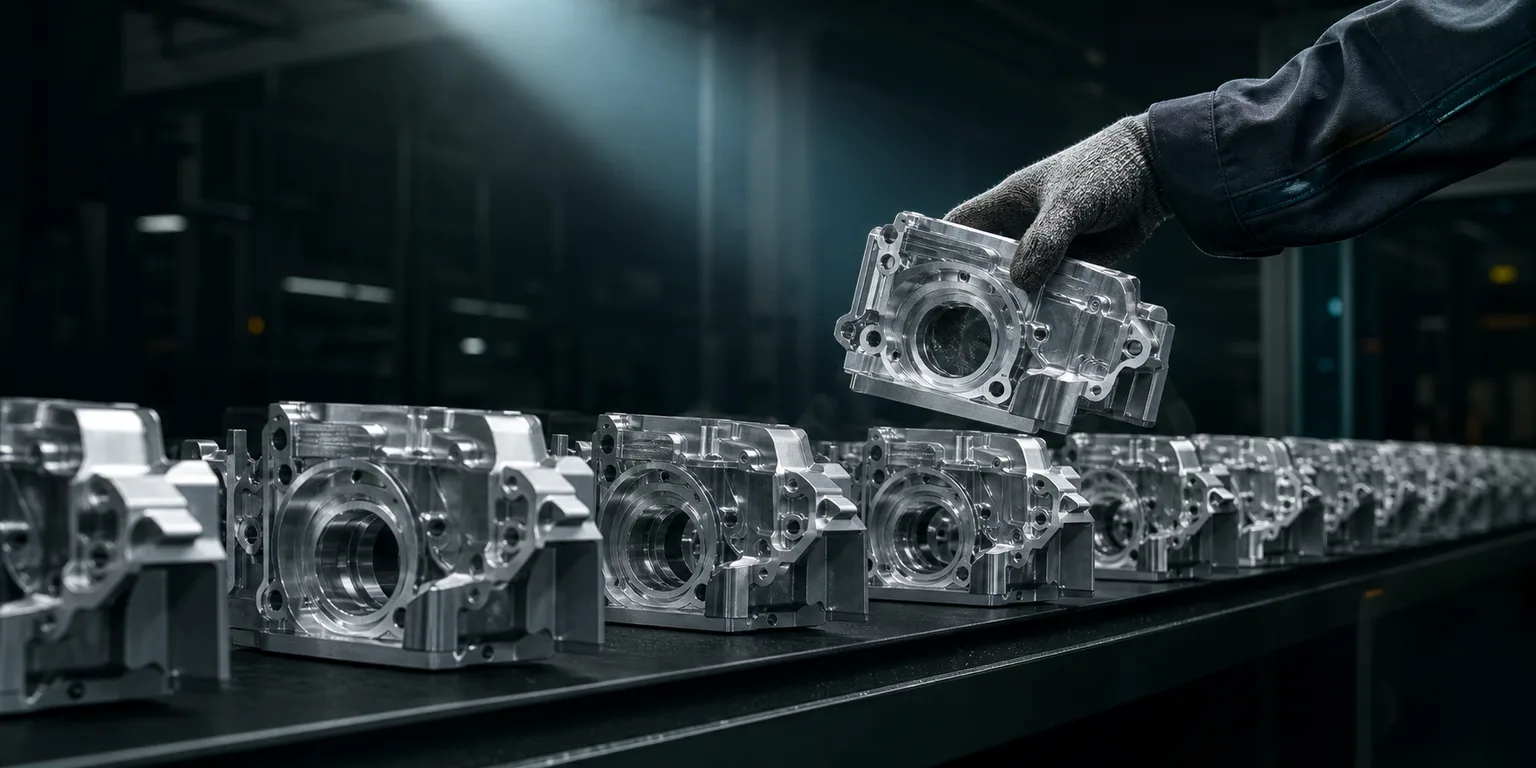
01The scenario of automotive & motorcycle component machining: volume, cost, traceability
Automotive-part CNC machining and automotive & motorcycle component machining have several scenario characteristics that clearly set them apart from other industries. First is volume production: the same part number is often produced repeatedly in batches of hundreds to thousands, and cycle time and machine utilization directly determine capacity and delivery. Second is cost sensitivity down to the cent: unit price is often squeezed razor-thin through the supply chain, and every extra few seconds per part or every extra trial cut per batch erodes an already limited margin. Third is the prevalence of quality traceability and PPAP-type documentation: OEMs and tier-one suppliers widely require dimensional records, process documentation and traceability, and attaching measurement and process data on delivery is the rule rather than the exception.
Manufacturing-systems theory has long noted that there is a structural trade-off among cost, quality and flexibility, and a plant's competitiveness comes from how it balances the three under a specific production type, not from optimizing a single point (Chryssolouris, 2006)[3]. Automotive and motorcycle components are precisely the typical scenario where "medium-to-high volume, cost-sensitive, high quality demands" overlap — and this determines that their requirements for machining preparation are completely different from a rush-job, single-piece custom scenario.
02Three pain points under unit-price pressure
Bringing the scenario characteristics down to the shop floor, the three most common pain points for automotive and motorcycle component shops are:
- Programming and trial-cut costs magnified by unit price: once amortized over the batch, the allowable preparation cost per part is very low; but the moment a new part or engineering change (ECN) arrives, reading the drawing, modeling, generating code and trial-cutting all have to be redone, and the material, labor-hours and machine utilization consumed by trial cuts stand out especially under thin margins.
- Frequent changeovers, multiple model years in parallel: automotive and motorcycle components are often many part numbers across many model years running at once, with frequent changeovers. Changeover time is non-productive time, and the slower the front-end preparation, the slower production rhythm recovers.
- Quality records are labor-intensive and prone to gaps: every batch has to leave dimensional and process records, and manual transcription and collation not only takes time but is prone to gaps during staff turnover or delivery crunches, making after-the-fact traceability difficult.
Classic texts on automation and production systems stress that standardizing process knowledge and making preparation repeatable is at the heart of stabilizing medium-to-high volume quality and cost; otherwise quality fluctuates with the state and experience of individual staff (Groover, 2019)[2]. This is exactly what AI CAM is meant to address in this scenario.
03AI response one: standardized program generation and tool-library constraints
The quality and cost of manufacturing engineering depend heavily on process planning and program verification before machining, not just on the machine's own precision (Kalpakjian & Schmid, 2020)[1]. AI CAM's first response capability in a volume scenario is to standardize "read drawing → model → generate code" and to let generation be constrained by in-house conditions:
| In-house constraint | Effect on batch quality / cost |
|---|---|
| Dedicated tool library (codes, standard lengths, cutting parameters) | AI selects tools that actually exist and habitual parameters, reducing tool-length setting errors and crashes, and keeping programs consistent across batches |
| Machine controller and travel, spindle-speed limits | Checked at generation time, avoiding exceeding machine capability and reducing rework discovered only on the machine |
| Historically successful programs | AI learns the shop's habitual approach strategies, staying close to existing practice for new parts and model-year revisions and shortening introduction |
For automotive and motorcycle component shops, this means front-end preparation for new parts and changeovers is more repeatable and less dependent on a single veteran's on-the-spot memory — process knowledge is deposited into the tool library and program templates, rather than lost with staff turnover. For a fuller understanding of "how AI turns a 2D drawing into verifiable G-code," see the pillar article "The Complete Guide to CNC Automated Programming".
04AI response two: simulation to cut trial cuts, AI dimensional verification to leave records
Thin-margin volume production dreads trial cuts eating into margin. AI CAM's second response capability is to use cutting simulation before the machine runs to preview the toolpath and check for gouging, remaining stock, fixture interference and travel overruns, blocking foreseeable problems before the trial cut and reducing waste of material and labor-hours. For a cost-sensitive scenario, the benefit shows up directly in yield and utilization.
The second layer is AI dimensional cross-checking: after the 3D model is generated, an independent second AI compares the model dimensions against the 2D drawing callouts one by one, proactively flags anomalies, and outputs the comparison result as a list. This step not only reduces missed checks but, more crucially, leaves a record — the comparison list, tool and parameter versions, and simulation versions can all be preserved, becoming a technical working draft for later quality traceability. The cost–quality balance discussed in manufacturing-systems theory essentially relies on this kind of front-end verification, trading lower preparation cost for more stable output (Chryssolouris, 2006)[3].
It should be noted that simulation and AI comparison "help discover problems," they do not guarantee conformance. The actual measurement of the production first article, and the final interpretation of tolerance and datum, still belong to QA and shop-floor expertise. For details on pre-machining gatekeeping and crash protection, see "AI Dimensional Verification and Measurement".
05Quality traceability and PPAP-type documents: making AI output an auditable record
The quality-system requirements common in the automotive industry (such as the IATF 16949 family of systems) emphasize process standardization and traceability — every product must be traceable to which program version, which tools and parameters, and which verifications produced it. If designed well, AI CAM is itself a source that generates these records:
- Program and parameter version records: each generated G-code, tool list and cutting parameters are versioned, so differences can be compared at engineering-change time.
- Simulation and comparison records: cutting simulation results and the AI dimensional comparison list are preserved as supporting evidence for pre-machining verification.
- Sign-off point records: human review sign-off for tolerance, datum, first article and pre-machining is embedded into the existing document-control flow.
The boundary here must be stated clearly: AI output is supporting evidence and a working draft, not a substitute for measurement, and it does not claim to make the plant automatically comply with any standard. The measured dimensions, first-article inspection and signatures required for PPAP-type documents must still be measured and owned by QA using the customer-specified method. Folding AI output into the existing quality system, rather than setting up a separate parallel set of records, is the correct approach when adopting. The automation literature also reminds us that traceability holds up by systematically recording the preparation and verification process, not by writing it up after the fact (Groover, 2019)[2].
06Drawing-preparation advice for customers placing orders
In volume and traceability scenarios, drawing quality directly affects introduction speed and record completeness. A few suggestions for automotive and motorcycle component customers placing orders:
- Provide native electronic drawing files (DWG) first: dimensions, hole positions and threaded holes are structured data, giving AI drawing interpretation, modeling and dimensional comparison the highest accuracy; PDFs or scanned drawings need focused review of tolerance frames, and phone photos serve only as an aid.
- Mark key dimensions and inspection characteristics clearly: annotate on the drawing the key dimensions, GD&T datums and special characteristics that PPAP-type documents will measure, so AI comparison and later measurement both stay focused.
- Include model-year / version and change notes: when multiple model years run in parallel, clear version and ECN notes let programs and records correctly correspond to part-number versions.
- Provide volume and takt requirements: so the preparation stage plans travel, spindle speed and tool strategy toward the production takt from the start, rather than adjusting after the fact.
If at the quotation stage you want faster manufacturability feedback and estimates, see "How AI Speeds Up CNC Quotation and Manufacturability Interpretation". To return to the product overview, see the BestAI CAM product home, and for other scenario articles, see the Blog index.
07FAQ
Automotive-part CNC machining is high-volume, and AI CAM only has to program once before it's reused. Is it still worth adopting?
Yes, but the value lies elsewhere. Programming a single part in a large batch can be amortized, so AI CAM's benefit isn't one-time time savings but changeover and new-part introduction: automotive and motorcycle components are typically many part numbers across many model years in parallel, with frequent new parts and engineering changes, each requiring a fresh cycle of reading the drawing, modeling, generating code and trial-cutting. AI drawing interpretation, modeling and standardized program generation shorten the front-end preparation, letting high-mix low-volume changeovers return to production rhythm faster.
The customer requires PPAP-type dimensional and process documentation. Can AI output serve as a quality record?
AI's role is to help generate and preserve records, not to replace QA sign-off. After modeling, an independent AI can cross-check the model against the drawing dimensions and output a comparison list, retaining tool, parameter and simulation version records as internally traceable technical documentation. The final measurement data, first-article inspection and PPAP-type documents must still be measured and signed by QA using the customer-required method — AI output is supporting evidence and a working draft, not a substitute for measurement.
We already run an IATF 16949 quality system. Will adopting AI disrupt our existing process?
AI CAM should be embedded into the existing quality system, not set up as a separate one. The quality-system requirements common in the automotive industry emphasize process standardization and traceability, and AI's standardized program generation, tool-library constraints and simulation verification map directly onto that spirit, with human review sign-off points (tolerance, datum, pre-machining) explicitly defined in the flow. We recommend folding AI-generated records into your existing document control rather than adding a parallel set of records.
Can AI-generated G-code be used directly on a production machine?
Running it directly is not recommended. AI-generated G-code should first pass cutting simulation and senior-technician review to confirm tooling, tool-length compensation, lead-in/lead-out and travel safety, bounded by the in-house tool library and the machine's travel and spindle-speed limits. First-article confirmation and human sign-off before production is an indispensable gate for stable batch quality.
Get notified when new articles and video guides go live — no inbox spam, one-click unsubscribe. (newsletter in Chinese)
READY FOR A CONTROLLED PILOT?
Run one real automotive/motorcycle component drawing through the whole volume-prep flow
From drawing quality, machine controller and tool library to quality-traceability needs, we help define an adoption approach that fits your shop.
Contact an adoption advisor Training courses08References
- Kalpakjian, S., & Schmid, S. R. (2020). Manufacturing Engineering and Technology (8th ed.). Pearson.
- Groover, M. P. (2019). Automation, Production Systems, and Computer-Integrated Manufacturing (5th ed.). Pearson.
- Chryssolouris, G. (2006). Manufacturing Systems: Theory and Practice (2nd ed.). Springer.