CNC MACHINING FUNDAMENTALS
How to Choose a Cutting Fluid: The Logic Behind Water-Soluble, Oil-Based and MQL
01What does cutting fluid actually do? Three core functions
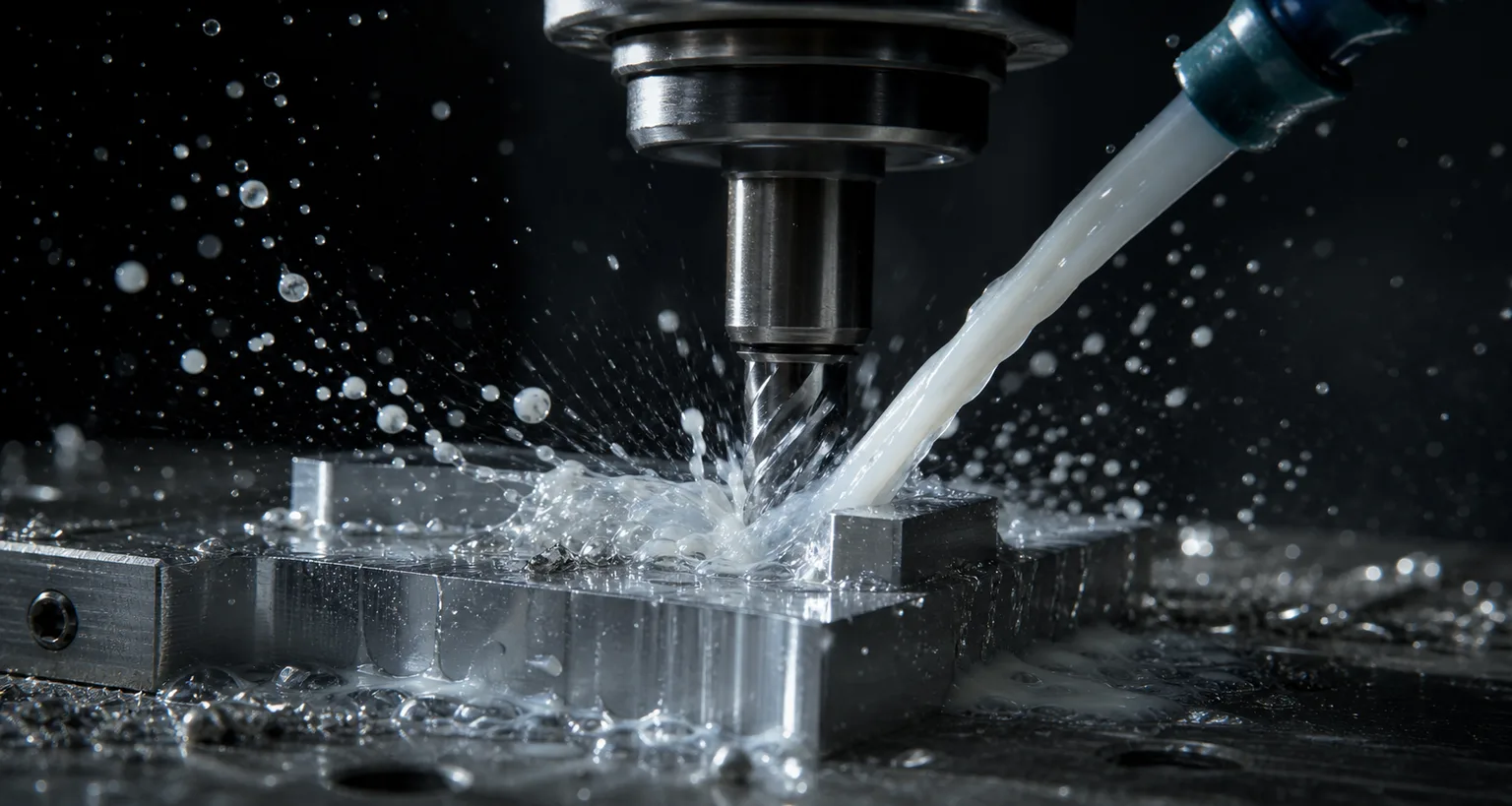
Cutting fluid (also called cutting oil or coolant) in CNC machining is not a dispensable consumable but a process factor that directly affects tool life, surface quality and dimensional accuracy. Manufacturing-engineering textbooks sum up cutting fluid's role in three core functions — cooling, lubrication and chip evacuation — plus the side benefits of rust protection and suppressing built-up edge (Kalpakjian & Schmid, 2020)[1].
- Cooling: during cutting most of the mechanical work turns into heat, concentrated at the tool tip and in the chip. Carrying that heat away slows tool wear and prevents thermal distortion of the part from affecting dimensions — especially important for high-speed machining.
- Lubrication: forming a lubricating film at the tool-chip and tool-workpiece contact faces lowers friction and cutting force, suppresses built-up edge (BUE), and improves surface finish. Low-speed, heavy-lubrication operations (such as tapping and reaming) rely on this in particular.
- Chip evacuation and cleaning: a fluid stream flushes chips away from the cutting zone and machined surface, avoiding re-cutting and scratching, and keeps chip flow smooth in enclosed regions such as drilled holes and slots.
It's worth noting that these three functions often pull against each other: a water-based cutting fluid cools best but lubricates relatively weakly; an oil-based one is the reverse. So selection is never about finding a single "best cutting fluid," but about judging which function this operation is most short of — the starting point for every comparison that follows.
02Water-soluble, oil-based and MQL: comparing three options
The cutting fluids on the market fall roughly into three routes: water-diluted water-soluble (emulsion, semi-synthetic, full-synthetic), water-free oil-based (straight oil, cutting oil with extreme-pressure additives), and MQL minimum-quantity lubrication using a tiny oil volume. The table below compares their orientations qualitatively; actual selection still needs to be verified against material, operation and machine conditions.
| Comparison | Water-soluble cutting fluid | Oil-based cutting fluid | MQL minimum-quantity lubrication |
|---|---|---|---|
| Cooling capacity | Strong (water-based) | Weaker | Weak (oil mist + air) |
| Lubrication / EP | Moderate | Strong, EP additives possible | Moderate, local lubrication at contact |
| Typical use | General-purpose for most milling and turning | Tapping, reaming, broaching, hard-to-machine materials | Milling and drilling of aluminum and some steel |
| Waste fluid / cleaning | Needs concentration, bacteria and fluid-change management | Oil mist, cleaning and fire safety to watch | Almost clean, very little waste fluid |
| Maintenance burden | Medium-high (daily concentration care) | Medium | Low |
| Chip evacuation | Good (fluid stream flushes chips) | Medium | Limited (air blast) |
Boiled down to one line: short on cooling, choose water-soluble; short on lubrication, choose oil-based; want less waste fluid and maintenance with modest cooling needs, consider MQL. Most machining centers running general steel and aluminum operations rely on water-soluble as the workhorse; only heavy-lubrication operations such as tapping and deep-hole reaming keep a separate oil-based cutting oil on hand. For how cutting conditions (feed, speed, depth of cut) pair with the cooling method, see this column's article on how to set cutting parameters.
03How to choose by material? The logic for aluminum, stainless steel and plastics
Material properties decide whether the cutting fluid should lean toward cooling or lubrication. Below is the qualitative logic for several common material classes; specific parameters still follow the tool supplier's recommendations and on-site test cuts.
- Aluminum alloys — fears gumming and built-up edge: aluminum is soft and conducts heat well, and its main problem is surface scoring from gumming and built-up edge. The focus is lubrication and chip flushing, commonly water-soluble cutting fluid or MQL; avoid formulations that react with aluminum, discolor and go rancid. For aluminum machining points, see the aluminum machining guide.
- Stainless steel and hard-to-machine materials — need extreme pressure, fear work hardening: stainless steel conducts heat poorly and work-hardens easily, so the cutting zone runs hot and the tool is heavily loaded. These materials favor cutting fluids with extreme-pressure (EP) additives to withstand high contact pressure, and need ample cooling to slow tool wear. For the overall strategy on stainless steel and other hard-to-machine materials, see machining stainless steel and difficult materials.
- Plastics and engineering plastics — often dry-cut or lightly cooled: most plastics conduct heat poorly and have low melting points, and excess moisture or a chemically incompatible cutting fluid can cause water absorption, stress cracking or contamination. Many plastic parts can be dry-cut with compressed-air chip evacuation, using a compatible small amount of cooling when needed.
- Cast iron — commonly dry-cut: the graphite in cast iron is itself lubricating and the chips come off as powder, so it's traditionally dry-cut to avoid the powdery chips mixing with coolant into an abrasive slurry — but good dust collection is required.
04Concentration and maintenance: odor, skin and concentration management
Many shops blame cutting-fluid problems on "a bad brand," but the more common root cause is actually maintenance. Water-soluble cutting fluid is a living system, and its concentration, pH and cleanliness drift with use; poor maintenance produces the following:
- Odor and bacterial growth: low concentration, weekend shutdowns, oil-water separation and chip buildup all let anaerobic bacteria grow and give off a smell. The fix is to regularly measure concentration with a refractometer, top up water and additives to keep the ratio, skim tramp oil, clear chips and schedule a fluid-change cycle.
- Skin and airway irritation: when concentration is too high, cleaning insufficient or protection inadequate, operators can develop cracked or allergic skin. Sensible concentration, gloves and hand-washing facilities, and oil-mist collection are usually more effective than switching brands.
- The knock-on effects of concentration imbalance: too dilute means insufficient lubrication and rust protection, rusting parts and shorter tool life; too concentrated leaves a sticky film on the hands, raises cost and irritates skin more. Keeping within the supplier's recommended range is fundamental.
05How cutting fluid relates to tool life and process monitoring
Choose the cutting fluid right and maintain it well, and the most direct payoff is tool life and machining stability. Tool wear, cutting temperature and cutting force are all closely tied to the cooling-and-lubrication conditions, and modern machining increasingly emphasizes capturing these states with sensing and monitoring — an authoritative review of machining monitoring notes that tool wear, breakage and process state can be monitored online through force, vibration, temperature and acoustic-emission signals, and the cooling-and-lubrication conditions are one of the key variables affecting those signals and tool life (Teti et al., 2010)[2].
In other words, cutting fluid is not an isolated consumable choice but part of the whole cutting system: with the same tool and the same set of parameters, whether the cooling and lubrication is on point can make a big difference in tool life and surface quality. When a shop starts adopting tool-life management or process monitoring, factoring in the cooling method and concentration state as variables is what lets the data be read correctly (Teti et al., 2010)[2]. This is also why stable machining prep — the right parameters, tool and cooling pairing — makes downstream monitoring and quality interpretation more reliable (Kalpakjian & Schmid, 2020)[1].
06When is dry cutting OK?
Dry machining, or near-dry (including MQL), has drawn attention in recent years for environmental, waste-disposal-cost and workplace considerations. Not all machining needs cutting fluid flooded on; dry or near-dry is often viable in the following cases:
- The material allows it: cast iron, some plastics, and certain chip-breaking-dominant operations get acceptable tool life and surface with dry cutting or compressed air.
- The tool coating supports high heat: modern coated tools (such as TiAlN) still hold performance at high temperature, making dry cutting or MQL more viable.
- You don't want coolant contamination or water absorption: some plastic, medical or food-related parts actually need to avoid cutting-fluid residue.
But deep-hole machining, high-heat heavy cutting with a large depth of cut, and enclosed geometries that need a strong fluid stream to evacuate chips still rely mainly on wet cutting. The criterion isn't "flooded or not" but which cooling method has the lowest total cost at an acceptable tool life, surface quality and dimensional stability. Before adopting MQL or switching to dry cutting, always run a small-batch validation on real tool life and surface quality before rolling it out fully.
07FAQ
Do you always have to use cutting fluid? When is dry cutting OK?
No, it isn't mandatory. Cutting fluid's value lies in cooling, lubrication and chip evacuation, but for cast iron, some plastics and certain chip-breaking-dominant operations, dry cutting or compressed air alone is enough, and it spares you coolant maintenance and waste-fluid disposal. Whether to cut dry depends on the material, tool coating, cutting speed and chip-evacuation needs, judged by whether tool life and surface quality are acceptable.
What's the difference between water-soluble and oil-based cutting fluid?
Water-soluble is diluted with water, cools strongly and is more economical and cleaner — the general-purpose choice for most milling and turning. Oil-based has stronger lubrication and EP performance and better rust protection, common for tapping, reaming, broaching and hard-to-machine materials, but cools less with higher oil-mist and cleaning costs. The key trade-off is whether this operation is short on cooling or on lubrication.
What do I do about smelly cutting fluid and workers' skin allergies?
Smelly water-soluble cutting fluid is mostly caused by out-of-control concentration, bacterial growth or oil-water separation, needing regular concentration measurement, water and additive top-ups, tramp-oil skimming and tank cleaning. Skin problems are often linked to over-high concentration, insufficient cleaning or inadequate protection. Establishing concentration measurement and a fluid-change cycle, and providing gloves and hand-washing facilities, is more fundamental than switching brands.
What machining is MQL minimum-quantity lubrication suited to?
MQL sprays a tiny amount of oil mist at the cutting zone, sitting between wet and dry cutting, and suits milling and drilling of aluminum alloys and some steel parts, reducing coolant usage, waste fluid and cleaning burden. But its chip-evacuation and cooling capacity is limited, so deep holes, large depths of cut and high-heat heavy cutting still rely mainly on wet cutting; verify with real tool-life and surface-quality tests before adopting.
We'll let you know when new articles and video briefs go live — no inbox flooding, one-click unsubscribe. (newsletter in Chinese)
FROM DRAWING TO A VERIFIABLE PROGRAM
Once you've picked the cutting fluid, can machining prep be faster and steadier?
Cutting fluid is a shop-floor craft; we focus on the stage before it — turning a 2D drawing into a 3D model and G-code verified by simulation and cross-checking AI, so the pairing of parameters, tools and cooling rests on stable machining prep.
Talk about your machining-prep flow Training courses08References
- Kalpakjian, S., & Schmid, S. R. (2020). Manufacturing Engineering and Technology (8th ed.). Pearson.
- Teti, R., Jemielniak, K., O'Donnell, G., & Dornfeld, D. (2010). Advanced monitoring of machining operations. CIRP Annals, 59(2), 717–739.