DIFFICULT-TO-MACHINE MATERIALS
Titanium Machining Guide: Why Ti-6Al-4V Is a Tool Killer
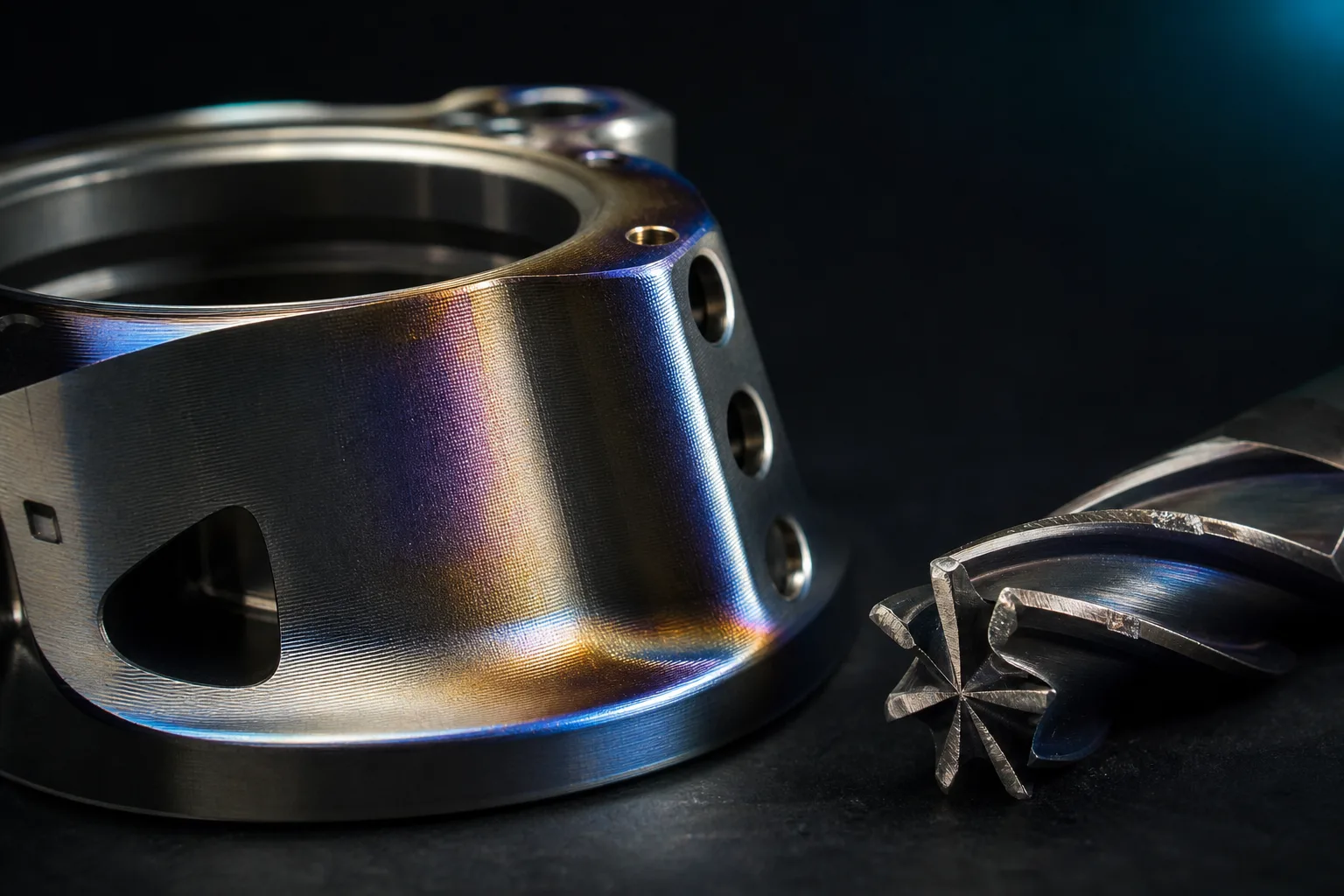
01What makes titanium hard to machine? Start with why it's called a tool killer
Titanium machining is widely regarded as one of the toughest problems in metal cutting, and its flagship material Ti-6Al-4V is often called a "tool killer" outright by engineers. Interestingly, titanium's hardness isn't especially high — what truly makes it hard to machine is a set of mutually reinforcing physical and chemical properties. Classic manufacturing-engineering textbooks group titanium alongside nickel-based superalloys as "difficult-to-machine materials," noting that they share high edge temperatures and short tool life during cutting, and must be handled with dedicated strategies rather than the same approach used for ordinary carbon steel[1].
For a job shop, this means quoting, tooling, and time estimation for titanium parts can't simply mirror steel. Understanding "where the difficulty lies" is what lets you put machining strategy and tool management in the right place.
02Titanium's three cardinal sins: low conductivity, low modulus, high reactivity
Titanium's difficulty can be boiled down to three mutually amplifying material properties — call them the "three cardinal sins." All three map onto how manufacturing-engineering texts characterize difficult-to-machine materials[1].
- Low conductivity, heat pools at the edge: titanium's thermal conductivity is far lower than steel's, so the heat generated during cutting isn't carried away by the chip and instead concentrates in the tiny region around the tool tip and cutting edge. That high temperature directly accelerates tool wear and makes the tool material more prone to softening and failure.
- Low elastic modulus, the workpiece springs back: titanium has a relatively low elastic modulus, so it deforms heavily under cutting load and springs back noticeably once released. This produces dimensional and form errors in thin-walled or slender parts and keeps the flank rubbing against the finished surface, generating heat in a vicious cycle.
- High reactivity, prone to sticking: at high temperature titanium is chemically active and readily reacts with the tool material, causing adhesion (built-up edge) and diffusion wear that chips the cutting edge or forms a built-up edge, further degrading surface quality.
The shared result of these three sins is a persistently high edge temperature and drastically shortened tool life. Understanding them is understanding the starting point of every machining strategy that follows: it all revolves around "how to keep the cutting edge from overheating."
03Why Ti-6Al-4V is the mainstream titanium alloy for aerospace and medical
The titanium family has many members, but Ti-6Al-4V (an α+β alloy with roughly 6% aluminum and 4% vanadium) is all but the default choice in industry, accounting for the bulk of titanium usage. The reason is its very balanced combination of properties:
- High specific strength: its strength approaches that of many steels, yet its density is only about 60% of steel's — highly attractive for weight-critical aerospace structures.
- Excellent corrosion resistance: a stable oxide layer forms naturally on the surface, resisting corrosion in marine, chemical, and human-body environments.
- Good biocompatibility: compatible with human tissue and unlikely to trigger rejection, it's a common material for orthopedic implants and dentistry.
- Mature supply and heat treatment: specifications, stock, and heat-treatment processes are all relatively mature, with stable, traceable quality.
In other words, Ti-6Al-4V is mainstream precisely because it's "easy to use" — and the very properties that make it easy to use, high strength and poor thermal conductivity, are exactly what make it hardest to machine, making it simultaneously the most common titanium alloy and the most common tool killer.
04Strategy: lower speed, large depth of cut, rigid clamping, and heavy coolant
Faced with titanium's three cardinal sins, the core logic of a machining strategy is to control edge temperature, suppress vibration, and avoid work hardening. Authoritative texts on cutting mechanics and CNC design stress that any choice of cutting parameters must be grounded in the mechanical and thermal/vibration behavior of the tool–workpiece system — otherwise you get, at best, tool marks and dimensional defects, and at worst tool breakage and edge chipping (Altintas, 2012)[2]. Applied to titanium, a few common principle-level directions emerge:
- Lower cutting speed: reducing cutting speed is the most direct way to control edge temperature, avoiding the high heat that accelerates sticking and diffusion wear. This is why titanium "shouldn't blindly chase high spindle speeds."
- Keep a stable depth of cut and feed, avoid air rubbing: titanium work-hardens easily, so repeatedly grazing the same surface hardens the top layer and makes it harder to cut. Keeping a sufficient, stable depth of cut so the edge bites into un-hardened material is actually better than blindly reducing the depth — this is where the "large depth of cut" logic comes from.
- Rigid clamping and a rigid tool system: titanium's low elastic modulus and tendency to vibrate demand very high rigidity from the machine, fixtures, and toolholder. Clamping should be short and stable and overhang short, to suppress chatter and spring-back error.
- Ample, well-directed cooling: because heat concentrates at the edge, ample cooling/lubrication precisely directed to the cutting zone is critical for extending tool life and improving surface quality.
05Tool-wear monitoring: turning tool changes from "gut feel" into "evidence-based"
A major pain point in titanium machining is short tool life and frequent tool changes, and getting the timing wrong is costly: change too early and you waste tool cost; change too late and edge chipping can scrap the workpiece or even damage the spindle. The traditional approach is to change tools on a fixed schedule based on a veteran machinist's experience, but titanium's wear rate is highly condition-dependent, so a fixed schedule is often not precise enough.
A more reliable direction is to bring in tool condition monitoring (TCM). CIRP's review of machining monitoring notes that changes in signals such as cutting force, vibration, acoustic emission, and spindle current/power can be used to estimate tool-wear and breakage trends and issue warnings before the tool fails; fusing multiple signals significantly improves detection reliability (Teti et al., 2010)[3]. For materials like titanium — "short tool life, high tool-change cost, severe consequences of failure" — upgrading the tool-change decision from "gut feel" to "signal-based evidence" pays off especially well.
Even if you can't install a full sensor suite at once, you can start recording the most readily available signal (such as spindle load trend) and gradually build up your own shop's titanium tool-life data.
06Applications: titanium machining in medical devices and aerospace
Titanium is hard to machine yet hard to replace, because its applications tend to fall in fields where "safety and reliability can't be compromised":
- Medical devices: orthopedic implants, spinal and joint components, dental implants, and surgical instruments value exactly Ti-6Al-4V's biocompatibility and corrosion resistance. Such titanium parts carry extremely strict tolerance, surface, and traceability requirements, and neither machining nor inspection can afford an error. For further reading, see Medical Device Machining and AI CNC.
- Aerospace structures and fasteners: airframe structural parts, fasteners, and turbine-related components value titanium's high specific strength and temperature/corrosion resistance; machining also often involves thin walls, deep cavities, and complex surfaces, raising the difficulty another notch. For further reading, see Aerospace Part Machining and AI CNC.
Titanium isn't the only material that gives engineers headaches. Stainless steel, nickel-based superalloys, and others each have their own machining challenges. For a more comprehensive view of the shared strategies for difficult-to-machine materials, see Machining Strategies for Stainless Steel and Difficult Materials.
07The role of AI: bounded by the shop's titanium parameter table, simulation first
When it comes to using AI to assist titanium machining, the most important thing is to draw the line first: material behavior is not something AI can infer out of thin air. Titanium's three cardinal sins, tool-change strategy, and cooling method all depend heavily on the titanium experience each shop has accumulated. So AI's reasonable role with titanium is to speed up preparation within the boundaries of existing knowledge, not to pass judgment on the material:
- Bounded by the shop's titanium parameter table: record the shop's existing titanium tools, cutting parameters, machine travel, and spindle-speed ceilings first, so that when AI generates toolpaths and G-code it's constrained by them — drafting only within the range the shop "already knows works," and avoiding parameters divorced from shop-floor conditions.
- Simulation first, machine second: titanium test cuts are expensive and unforgiving, all the more reason to check for gouges, remaining stock, fixture interference, and travel overruns with 3D cutting simulation before machining — heading off foreseeable errors at the simulation stage rather than trial-and-error on costly titanium stock.
- Keep a human in the loop: the final parameters, clamping strategy, and machine-side sign-off for titanium still rest with an engineer who knows titanium. AI speeds up reading drawings, modeling, and simulation while the engineer retains final judgment — a division of labor to defend especially firmly with difficult-to-machine materials.
In other words, AI frees up time for the places that genuinely need judgment (material, tolerance, process method), while the repetitive modeling, code generation, and simulation are handed to the machine to accelerate. To understand this full "AI speeds up preparation, the master keeps judgment" workflow, return to the pillar article BestAI CAM product overview and the Blog for further reading.
08FAQ
Why is titanium harder to machine than steel?
Mainly three intrinsic properties: titanium's low thermal conductivity concentrates cutting heat at the edge and accelerates wear; its low elastic modulus makes the workpiece spring back under load, producing dimensional error and frictional heat; and its high chemical reactivity makes it react readily with the tool at high temperature, causing built-up edge and diffusion wear. Even though its hardness isn't especially high, it remains far harder to machine than ordinary carbon steel.
Should Ti-6Al-4V be machined at high or low spindle speed?
In principle, titanium alloys generally lean toward "a lower cutting speed with a stable depth of cut and feed" to control edge temperature and avoid work hardening, combined with rigid clamping and ample cooling. But the exact speed, feed, and depth of cut must be decided against your shop's titanium parameter table based on tool, machine, and cooling conditions — there is no universal number.
Titanium tools wear out fast — how do I judge when to change them?
Rather than simply changing tools on a fixed schedule, a more reliable approach is tool condition monitoring: estimating the wear trend from changes in signals such as cutting force, vibration, acoustic emission, or spindle current, and warning before the tool fails. Fusing multiple signals improves detection reliability, which suits materials like titanium where tool life is short and tool-change cost is high.
Can AI generate machining parameters for titanium alloys?
AI can help draft toolpaths and programs within the boundaries of your shop's existing titanium parameter table, and check for gouges, interference, and travel safety up front with 3D cutting simulation. But the final parameter decisions and machine-side sign-off should still rest with an engineer who knows titanium — AI's role is to speed up preparation and put simulation first, not to draw conclusions about material behavior.
Get notified when new articles and video guides go live — no inbox spam, one-click unsubscribe.
MACHINING TITANIUM PARTS?
Titanium is hard and unforgiving — all the more reason to put simulation first
From the titanium tool library and machine controllers to the tolerance and security needs of medical and aerospace work, we help define the AI-assisted rollout that fits your shop.
Contact a deployment consultant Training courses09References
- Kalpakjian, S., & Schmid, S. R. (2020). Manufacturing Engineering and Technology (8th ed.). Pearson.
- Altintas, Y. (2012). Manufacturing Automation: Metal Cutting Mechanics, Machine Tool Vibrations, and CNC Design (2nd ed.). Cambridge University Press.
- Teti, R., Jemielniak, K., O'Donnell, G., & Dornfeld, D. (2010). Advanced monitoring of machining operations. CIRP Annals, 59(2), 717–739.