PROCESS SELECTION GUIDE
CNC, Laser Cutting or Sheet Metal — How to Choose? The Logic Behind Three Processes
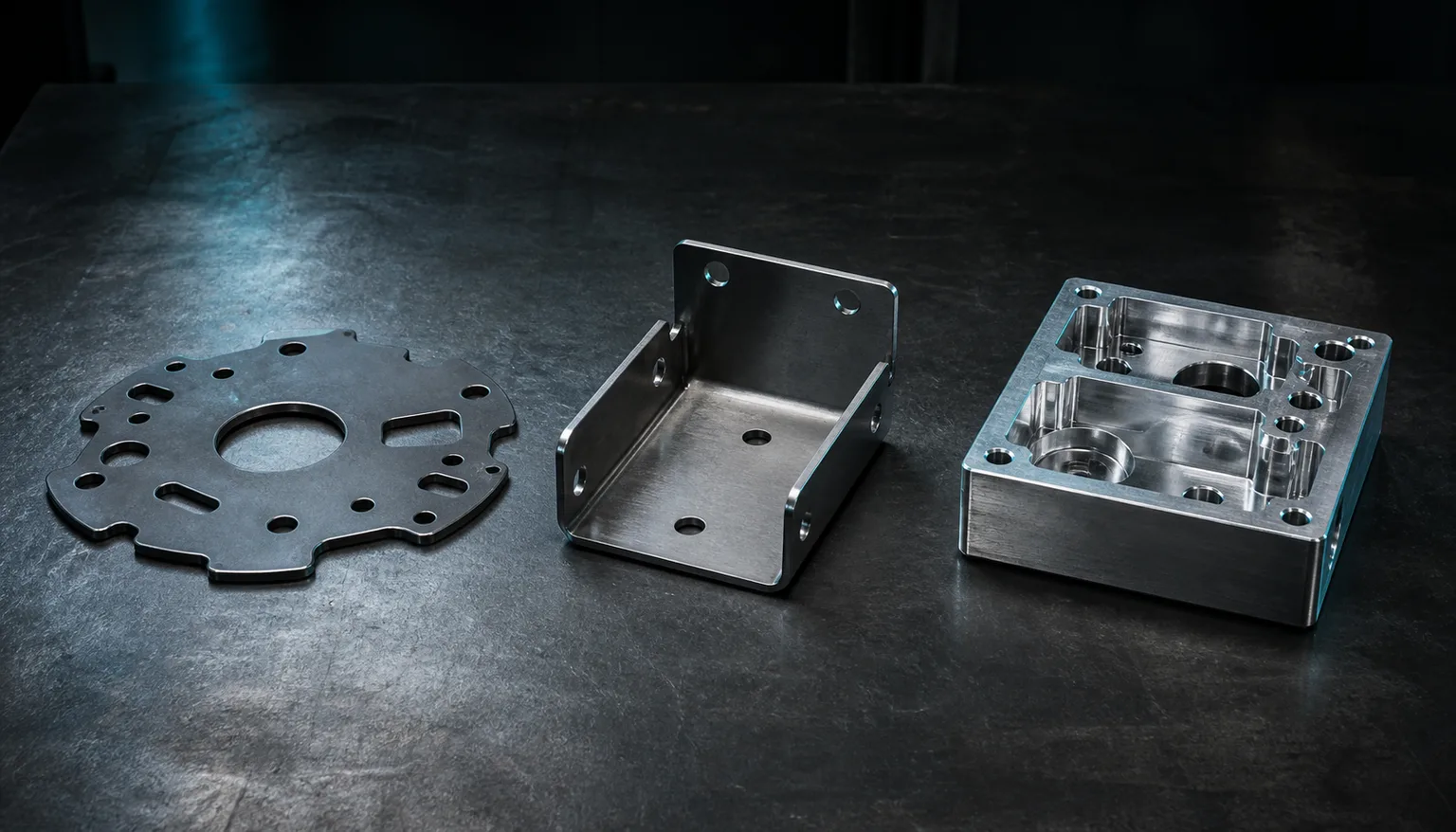
01Dimension first, process second: the basic logic of selection
When making a laser cutting, sheet metal and CNC comparison, the easiest trap is treating them as three pricing options for the same thing and then just picking the cheapest. In reality, these are processes with different roles: manufacturing engineering broadly divides machining into "material removal" and "plastic forming." The former uses cutting tools or energy to remove excess material; the latter uses external force to deform material without breaking it[1]. Laser cutting and CNC belong to removal, sheet-metal bending belongs to forming — their starting points are simply different.
A more practical order of thinking is: first look at which "dimension" the part's geometry belongs to, then choose the process. An outline and holes on a flat sheet is a 2D problem; folding a flat sheet into a box or enclosure is a 2.5D forming problem; a solid with thickness variation, stepped faces, curved surfaces, precision mating holes and threads is a 3D machining problem. Manufacturing-systems research also reminds us that process selection must simultaneously align with the part's technical requirements and with production quantity and cost targets; no single process is best in every situation[2]. Get the dimension right, and cost and quality can then be discussed.
02Laser cutting: the blanking workhorse for 2D sheet profiles
Laser cutting uses a high-energy beam to cut through material on a flat sheet, cutting outlines and internal holes along a programmed path. What it does best is 2D profile blanking on flat sheet: sign lettering, sheet-metal flat patterns, gaskets, bracket blanks, and all kinds of sheet parts that need complex outlines but a single thickness. The kerf is fine, there is no contact, and changing the drawing just means changing the program rather than making a die, so small-batch, high-variety, complex-outline sheet parts are especially economical.
Its limits are equally clear. Laser handles the "cutting through flat sheet" job and cannot produce depth-varying 3D features such as counterbores, stepped faces or lateral grooves. On thick plate the cutting speed and edge quality drop, the hole walls often carry slight taper and a heat-affected zone, and tighter mating holes still need post-processing. In other words, laser solves the "outline" quickly and well, but "3D features" are not in its coverage.
03Sheet metal: the forming process that folds flat sheet into enclosures
Sheet metal is a set of processes centered on plastic forming — bending, stamping, punching, tapping (extruded/flanged holes) and so on — that turn flat sheet into folded enclosure parts: control boxes, chassis, panels, brackets and duct parts are all typical. The principle of forming is to make metal deform permanently above its elastic limit but before fracture, so springback, minimum bend radius and material ductility must be considered[1]. When well designed, a few folds of a flat sheet can replace a welded assembly, with good rigidity, light weight and low volume-production cost.
The blanking stage of sheet metal is often done by laser or turret punch, and only then bent; so "sheet metal" on the shop floor is often a combination of "blanking + bending + finishing" rather than a single action. Its limitation is that every feature must ultimately be formable from a single unfolded flat sheet. Material that is too thick, inside bends that are too small, or precision structures that require solid stock go beyond the scope of sheet metal and have to return to CNC.
04CNC: 3D solid features and precision holes and threads
CNC machining (mainly milling and turning) rotates the cutting tool or the workpiece to remove excess material from stock layer by layer, producing the 3D solid features on a drawing: stepped faces, pockets, curved surfaces, precision mating holes, counterbores and internal threads. Compared with laser and sheet metal, which mainly work on "sheet," CNC faces solids with thickness and 3D structure, and it achieves the highest dimensional tolerance and surface precision — making it the workhorse for precision mating parts, mold components and load-bearing structural parts[1].
The price is time and material. The nature of CNC's tool-by-tool removal makes it slower than laser at large-area pure-outline blanking and costlier than sheet metal at thin-shell parts; material utilization is also lower. So CNC's sweet spot is the portions that "must have 3D features and must have tight tolerances," not a substitute for sheet blanking. To understand more fully what CNC can do and how precise it gets, read on with What is CNC machining.
05Six-dimension decision table: comparing the three processes at a glance
Organizing the division of labor above into a table lets you, before requesting a quote, check which cell the part falls into and quickly judge which process to approach, or whether you need a combination.
| Dimension | Laser cutting | Sheet metal (bending/stamping) | CNC machining |
|---|---|---|---|
| Thickness / form | Single-thickness flat sheet; thin to medium plate is best | Thin to medium plate; can be folded into enclosures | Stock or thick plate; can have thickness variation |
| Achievable precision | Good outline; hole walls have taper and heat effect | Affected by springback; bend-angle tolerance is looser | Highest; can reach tight dimensional and geometric tolerances |
| Holes and threads | Through-holes OK; mating holes/threads need post-processing | Punched holes, extruded threads OK; precision holes still need post-processing | Drilling, reaming and tapping done in one go |
| 3D features | No (pure 2D outline) | 2.5D such as bends and formed embosses | Full 3D such as stepped faces, pockets and curved surfaces |
| Suitable quantity | Small-batch high-variety to medium volume; no die needed | Medium to high volume is most economical (fixtures amortized) | Single parts to medium volume; high flexibility for complex parts |
| Cost tendency | The more complex the outline the more economical; thick plate gets pricey | Low unit price at volume; die tooling is a threshold | Higher labor and material cost, traded for precision |
The table above is a qualitative comparison based on common industry situations; actual figures vary with material, machine, batch and supplier, so rely on the quote and first-article confirmation.
06A common combination: laser blanking then CNC finishing
In practice, many parts are not a "pick one of three" but a matter of assigning different features to the process that does each best. The manufacturing-systems literature stresses that the value of process planning lies in pairing each feature with a suitable machining method so the overall time and cost are optimal, rather than forcing a single process to do everything[2]. A few common combinations:
- Laser blanking → CNC finishing hole positions: First use laser to quickly cut the sheet outline and rough hole positions, then have CNC ream, tap and bore the precision mating holes, balancing blanking speed and hole-position precision.
- Laser flat pattern → bending → CNC datum faces: Laser cuts the sheet-metal flat pattern, it is folded into an enclosure, and then CNC machines the datum faces or mounting holes that must fit precisely with other parts.
- CNC solid body + sheet-metal shell: The core part that is critical for loading and precision is CNC-machined; the outer protective shell and panels are sheet metal, and everything is assembled into the finished product.
The premise of combining is that the drawing must state clearly "which dimensions are critical fits." As long as the tight-tolerance features are marked, the supplier can judge which portion goes to laser and which stays with CNC. If you are still torn over whether a part should be CNC or an additive process, you can also evaluate it alongside CNC machining vs 3D printing.
07Drawing preparation differences: DXF profile vs 3D features
The three processes need different drawing information; get the preparation right and quoting is both fast and accurate:
- Laser cutting: Mainly 2D profiles; providing a DXF flat drawing (outline lines and internal hole lines), material thickness and material is enough. Closed lines, consistent units and no duplicate lines are the keys to smooth laser quoting.
- Sheet metal: In addition to the unfolded outline, you also need to mark bend lines, bend angles and directions, inner bend radii and material thickness — because the flat-pattern dimensions and springback all relate to these.
- CNC: Involves 3D features, so it is best to provide a 3D model (STEP/IGES etc.) or a fully dimensioned multi-view engineering drawing, clearly marking tolerances, datums, thread specs and surface requirements.
For the differences and priorities of various DWG/DXF/STEP/IGES files in CNC scenarios, read on with How to choose common CNC file formats. When you are unsure of the process, the safe approach is to attach both 2D and 3D and mark the critical dimensions clearly, letting the supplier judge the division of labor for you. To organize your requirements more completely into a quotable package, see the machining RFQ guide.
08FAQ
What is the most fundamental difference between laser cutting, sheet metal and CNC?
The difference lies in geometric dimension and forming method. Laser cutting handles 2D profiles on flat sheet; sheet metal turns flat sheet into folded enclosures through bending and stamping; CNC removes material with cutting tools to make 3D solid features with thickness variation, stepped faces and precision holes and threads. The dimension determines the applicable scope, not which one is more advanced.
If I need precision hole positions and threads, can laser cutting alone do it?
Usually not recommended. Laser-cut holes have decent positional accuracy on thin sheet, but the hole walls often have taper and a heat-affected zone, so tighter mating holes, counterbores and internal threads still need drilling, reaming or tapping. A common approach is to laser-blank the profile, then have CNC finish the critical hole positions and threads.
Can multiple processes be combined on the same part?
Yes, and it is very common. For example, laser quickly blanks the outline, it is bent into an enclosure, and then CNC machines the datum faces and hole positions that need tight tolerances. Assigning each feature at design time to the process that does it best is usually more time- and cost-effective than forcing everything through a single process; the key is to clearly mark on the drawing which dimensions are critical fits.
Should I prepare 2D or 3D drawings when requesting a quote?
It depends on the process. Laser and most sheet-metal blanking are 2D-profile-based, so a DXF flat drawing plus material thickness, material and bend information is enough; CNC involves 3D features, so it is best to provide a 3D model or a fully dimensioned engineering drawing that marks tolerances, datums and threads. When unsure of the process, the safest bet is to attach both 2D and 3D and mark the critical dimensions clearly.
Get notified when new articles and video guides go live — no inbox flooding, one-click unsubscribe. (newsletter in Chinese)
NOT SURE WHICH PROCESS?
Hand us the drawing and let's assign the best process to each feature
From material thickness, precision, holes and threads to 3D features and quantity, we help judge which portion should be laser-blanked and which should be CNC-finished, and use cutting simulation and AI cross-verification to stop risks before the machine runs.
Contact a machining advisor Training courses09References
- Kalpakjian, S., & Schmid, S. R. (2020). Manufacturing Engineering and Technology (8th ed.). Pearson.
- Chryssolouris, G. (2006). Manufacturing Systems: Theory and Practice (2nd ed.). Springer.